Tag: Trans dogma

  • As a scholar of this stuff

    Another consignment of geriatric shoe manufacturers:

    https://twitter.com/thrasherxy/status/1236831989270970368

    Same old same old. Moore didn’t say anything “transphobic.” That’s all there is to this brand of “activism,” isn’t it – defining all dissent and argument as “phobic” and then pitching a “shut it down!!” fit on the basis of that wild definition. Everything except abject agreement and compliance is “transphobic” so…get aboard or get punished.

    Along with how domineering and highhanded it is, it’s so intellectually vacant.

    https://twitter.com/thrasherxy/status/1236835801373323267

    As a scholar of this stuff? What stuff? His field is American Studies. That’s not a science. On what basis are we supposed to think he knows more about the science than Hadley Freeman and Suzanne Moore?

    And nobody has any beef with trans people “just for LIVING” – that’s the usual lie that “activists” of this type resort to because they haven’t got anything better.

    I tell you what, though: this crap doesn’t work. I know that from experience. Having people shout slogans at you over and over and over instead of actually making an argument doesn’t work. Instead of persuading you or cowing you it pisses you off. Not recommended.

  • The patriarchy that oppresses us all

    Yet another – sorry, I hope to change the subject after this one.

    Yes but that’s a different sense of “defined.” A very different sense. Feminism has not been fighting for over a century for women to stop being women or stop being called women; it has been fighting for women to stop being limited and confined by their sex.

    But wait, it gets worse.

    To what end? We’ve seen to what end. Look at Rachel McKinnon and the other male athletes competing against women to see to what end. Look at Jessica Yaniv to see to what end. Look at Morgane Oger. Look at men in prison transing so that they can live among women instead of men. Look at men getting elected Women’s Officer in universities and political parties.

    But even more to the point…if the boundary between female and male is arbitrary, what can she possibly mean by “patriarchy”? What is it? What does it do? How does it oppress us? Why should we take it down?

  • Born without a sex

    Dawn Butler tells us children are born without a sex. Yes really: she said that.

    https://twitter.com/VictoriaPeckham/status/1229476741594439680

    It’s at 1:08 that she says it.

  • Things that affect real people

    Earlier today –

    https://twitter.com/Docstockk/status/1217065892430913536

    Fellow academic Alison Phipps responds:

    https://twitter.com/alisonphipps/status/1217117223795527680
    https://twitter.com/alisonphipps/status/1217117344473985024

    I am particularly struck by “These issues are not abstract thought experiments but things that affect real people.” This is a working academic talking, remember – a working academic claiming there is a gulf between things that affect real people and discussion of such things among academics. If that’s what she thinks why is she even an academic?

    Sex, gender, justice, equality, identity, material reality, truth, fantasy, lies, social contagion, intersectionality, rights, law, fairness, body, mind – all are “things that affect real people” and that’s why we discuss them and try hard to get them right. What an admission it is for an academic to say she thinks that discussion is just idle chat between unreal people.

    The item about “Two cis women debating trans equality” is also absurd, of course. It would be two women discussing whether men who call themselves women are literally women in all senses and also more marginalized than not-trans women and thus entitled to demand that feminism “center” them.

    I guess we should conclude that Phipps isn’t confident she can defend that claim and so is making silly excuses.

  • The first principle is that you must not fool yourself

    Andy Lewis on what the trans “movement” has done to skepticism:

    So, Rebecca Watson of @skepchicks has produced a video calling JK Rowling a ‘bigoted fuckface’. She comes to this conclusion because the Harry Potter author defended Maya Forstater after Maya lost an employment tribunal over her beliefs that sex is binary and immutable. 

    Don’t go thinking that’s hyperbole. I haven’t watched the video because I value my sanity, but I skimmed the transcript, and “bigoted fuckface” is right there at the beginning.

    JK Rowling, who you may know as the author of the theory that wizards don’t need indoor plumbing because they can just shit on the floor and then magic it away, has finally, officially come out as a TERF — aka a trans-exclusionary radical feminist, which is literally just an accurate description of what a TERF believes but apparently they think “TERF” is a slur so I will use a less-loaded term for this video: bigoted fuckface.

    Pause for laughter that doesn’t occur.

    Back to Andy:

    Rebecca is quite happy to use slurs to demonise Rowling & Maya because they disagree with her on science. (The mispronunciation is also unforgivable.) But let’s play Rebecca with a straight bat & address her thoughts on the science of sex to see if her views are justified.

    He does a science of sex explainer, the upshot of which is that male and female are not some wack new idea.

    Sex arises from the fact that we are evolved sexually reproducing organisms. Sex evolved deep in life’s history and has remained remarkably conserved – although there are many sex determination mechanisms in organisms.

    To suggest that there are more than two sexes, or even more extreme, that somehow sex forms a continuum, a distribution or a spectrum is completely incompatible with this view of life and sexual reproduction. (The idea that ‘sex is a spectrum’ is a core part of the credo of gender ideology.)

    So, how does Rebecca attempt this?

    In short, she does not. She nods her head to the complexity of sex development, but makes no attempt to suggest there is anything other than two sexes. It is almost as if she does not want you to see lack of rebuttal after just complaining the XX/XY mechanism is ‘too simplistic’.

    There is a referenced blog post though on why we should “Stop Using Phony Science to Justify Transphobia.” Like many blog posts in this genre, it makes a number of basic errors.

    But but but it was a Scientific American blog post, so how can it be wrong? Scientific American is always right! Except for those think pieces by Michael Shermer, of course…oh look, a squirrel.

    Rebecca goes on to a rhetorical trick though to appeal to the ‘diversity of humanity’. She claims that “male” or “female” are just a “shorthand” and that it “simply isn’t enough to account for the diverse array of beautiful human bodies in the world, and it’s anti-scientific to pretend as though it is.”

    No justification is given for this & it is another straw-man, since no one is claiming there is not a wide range of variation within people. Even sex characteristics can exist on a wide distribution of scale. Size can vary.

    The truth is rather banal – your sex is just one fact about you. An immutable fact. And there are many facts about you that make up the Whole You and “the diverse array of beautiful human bodies in the world”.

    The core of Maya Forstater’s beliefs in her court case were that sex was a binary and sex was immutable. Despite lots of angry words and invective The @skepchicks have failed to show that this is not true and have instead invoked straw man arguments and thinking errors.

    Which is not very…skep.

    “The first principle is that you must not fool yourself—and you are the easiest person to fool.”

    This was the defining message of Richard Feynman’s address to graduating students of CalTech in 1974.

    Feynman was describing the difference between having a scientific outlook in life and being fooled by false beliefs – no matter how much those beliefs were shared by those around you and how much effort you put into living by those beliefs.

    A lesson Feynman was called on to reiterate to the honchos at NASA who ignored what the engineers were telling them about the O-rings and cold temperatures, and so insisted the Challenger launch go ahead despite the engineers. An O-ring did indeed fail.

    As Feynman said, “So I call these things Cargo Cult Science, because they follow all the apparent precepts and forms of scientific investigation, but they’re missing something essential, because the planes don’t land.”

    I can’t help thinking we are seeing a lot of Cargo Cult Scepticism too right now about how we understand the nature of sex and gender. Worse, I think we are seeing Cargo Cult Progressiveness.

    The ideology of gender is one massive ‘just so’ story.

    It starts off with the required conclusions such as ‘transwomen are women’ and then works backwards. What must be true for this to be true? One thing that must be true is that our conceptualisation of biological sex must be wrong.

    Women cannot be female. Males and females must be mutable and blurred in distinction. All scientific facts must then be shoehorned into this outcome.

    But @skepchicks are part of a noble movement that questions authority and relies completely on science to get to the bottom of societies core beliefs!

    The problem is that this is easy when it comes to homeopathy and ghosts and gods and vaccine injuries.

    But there is a Cargo Cult Progressiveness now that insists you accept without question the New Progressive Movement of Gender. To question any aspect of this will result in instant excommunication. The social cost is high.

    And it would [look] like the (almost) entire US skeptical movement has decided to fool itself rather than be on the wrong side of this social movement. The cost to anyone is too high to question it.

    We see defenders of evolution such as @pzmyers reacting like the worst frothing mouth evangelical preacher when asked to defend the idea that women can have penises.

    One would have thought that Myers would have taken the opportunity to use this as a quirky way to explain how evolution works and ends up with counterintuitive results. But no. Shouting and screaming instead.

    We appear to have ended up with Cargo Cult Scepticism where all that is left is just the precepts and forms of debate but none of the challenging, debate, evidence gathering and – most importantly – thought.

    Slogans and epithets instead of thought.

    Blocking is the tool of the Cargo Cult Scepticism crowd. Blog posts the sources of evidence – not the primary literature. Denouncing heretics is the cry rather than questioning and discussion.

    We are now at a place where scepticism is an Identity and not a set of tools. It is about belonging to the right crowd – ‘on the right side of history’. It is no longer about informing policy and social ideas with well founded science based on robust evidence.

    Maybe it was always like this. Maybe it was always just about screaming at homeopaths. But this is not good enough.

    In fact, it’s downright bad.

  • A smoke screen for her underlying bigotry

    Katelyn Burns explains the Maya Forstater ruling for readers of The New Republic:

    But a closer look at the case reveals that it doesn’t have much to do with a belief that “there are only two sexes in human beings … male and female,” as Forstater claims (and growing bodies of science dispute). In practice, Forstater was seeking legal cover to disregard the already established rights of trans people in the U.K.

    What rights? What rights of trans people was Maya “seeking legal cover to disregard”?

    Hers was a familiar argument—one that for too long has dominated mainstream coverage of trans rights.

    What rights are those though?

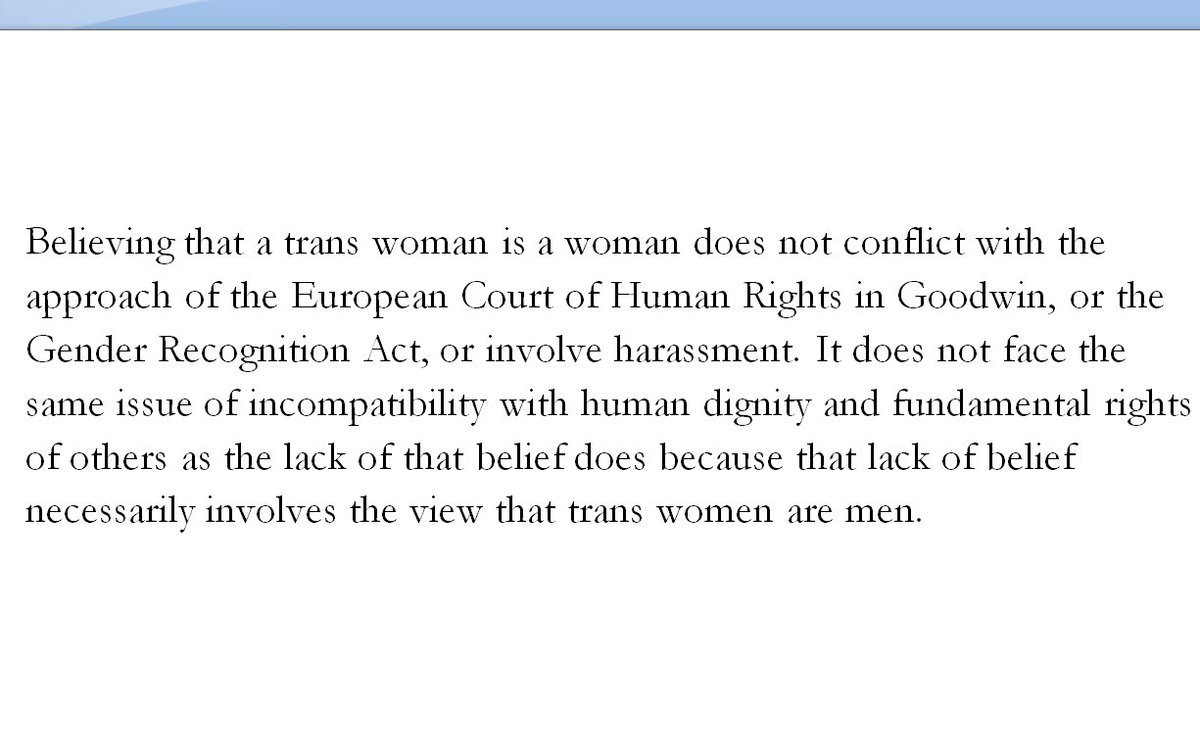
    A passage from employment judge James Tayler’s ruling explained it perfectly: “The claimant is absolutist in her view of sex and it is a core component of her belief that she will refer to a person by the sex she considered appropriate even if it violates their dignity and/or creates an intimidating, hostile, degrading, humiliating or offensive environment.”

    It’s not about what anyone “considers appropriate” though is it. It’s about safety, for one thing. Women sometimes need to know who is a man for their own safety. It’s not a whim, it’s not “absolutism,” it’s not random, it’s not being cruel or rude. It’s self-preservation. Women are given a lot of self-preserving advice about what to do around men, which seems to hint that women can be at risk from the presence of men in some situations. If we’re not allowed to know who is a man and who isn’t any more, how can we follow any advice of that kind?

    Forstater’s claim about protected belief was just a smoke screen for her underlying bigotry, and Tayler saw through it. “It is also a slight of hand to suggest that the Claimant merely does not hold the belief that transwomen are women,” he wrote in his judgment. “She positively believes that they are men; and will say so whenever she wishes.” The case, then, wasn’t so much about belief as it was about actions.

    But how does Katelyn Burns – who is a trans woman – suggest we deal with this issue of sometimes needing to know who is a man for our own protection? Just ignore it?

    In the U.K., trans people are protected on the basis of their “gender reassignment,” meaning that they should be treated as their transitioned genders under the law.

    “Treated as” – what does that mean? Does it mean the law is telling us to lie about what we perceive? Can a law really order us to do that?

    In her employment case, Forstater wanted her own beliefs to supersede the rights of those trans people.

    But what about our rights? What about our rights to deal in facts as opposed to fantasies? What about our rights to name things accurately as opposed to being forced to lie? Why don’t those rights matter?

    Winning her suit would have meant potentially nullifying protections for trans people and eroding emerging social norms that allow trans people to feel safe and respected in basic social interactions.

    What protections? Is it really “protection” to force other people to call you what you are not? That’s not my idea of a protection.

    I’m not convinced it’s about protection; I think it’s more about attention. If people are forced by law to use counter-intuitive pronouns for other people, then those forced people will have to pay constant attention to the people of pronoun so that they don’t get it wrong. It’s a wonder Trump hasn’t latched onto this wheeze yet.

    Anti-trans activists like Forstater can talk all they want about their simple and humble personal beliefs in the supposed immutability of biological sex, but the truth is, as the judge found, those views are—or should be—irrelevant to how trans people are treated in society and on the job.

    Then again you could say that people’s magic inner gender feels are irrelevant to how people at work refer to them.

    It doesn’t matter what Forstater believes about trans people or the body—the court found that it didn’t entitle her to misgender people. That’s why nondiscrimination laws exist in the first place.

    No it isn’t. Nondiscrimination laws in general have nothing to do with pronouns, and the reason they exist is to prevent injustice, not to indulge people’s personal fantasies about themselves.

    Cases like this—which pit the actual lives of trans people against the beliefs of somebody who decided to test her colleagues’ patience by posting over 150 anti-trans tweets in a single week—are a win-win for anti-trans activists.

    One, the tweets were not “anti-trans”; two, were Maya’s colleagues forced to read her tweets? Did she print them out and place them on her colleagues’ desks? Is it really any of her colleagues’ business what she tweets?

    If they prevail, they now have a new legal basis to treat trans people like garbage without reprisal.

    Saying that people cannot literally change sex is not “treating trans people like garbage.” People can’t literally jump over tall buildings; it’s not treating them like garbage to say so.

    I don’t think Katelyn Burns is garbage, but I certainly think this article is.

  • A male’s wish is his, and our, command

    A thread by Alessandra Asteriti:

    Short thread on Forstater case. I am not going to examine the law, I leave that to experts of equality law. I’ll focus on the language used by the judge, as revealing of male supremacy and incapacity to adopt the female point of view, or empathise with it.

    In para 92, the judge states as follows

    What is he saying here? He is saying that saying ‘transwomen are women’ is not harassment of women, but saying ‘transwomen are men’ is harassment of transwomen. He is saying what men want always takes precedence over what women want, or even need. He is saying men are offended if women point out that they are not women, even if biologically they are not, so women are only telling the truth. But women cannot be offended if men tell them woman is just a word invented by men and that can be modified by men.

    Women’s lived reality means nothing, and any man can erase it by getting a certificate, or even by self-declaring that he is now also a woman. We cannot be offended by a man reducing all our lives to a wish in his head, but men can be offended if we remind him that his wishes (even ‘enshrined’ in law) do not change material reality. Especially because women’s reality is a reality of oppression. TW do not want to partake of the oppression and do nothing to minimise it. They tell us they are women because they ‘present as women’. We are women because we are women.

    We are women in the world, because we were girls, and if we survived selective abortion, female infanticide, lack of care, FGM, period huts, childbirth deaths, rapes, dowry deaths, we become adults. In one simple sentence, the judge ignored the reality of women’s existence and elevated the wish of a subsection of men to demand we submit to their vision of who they are, thereby negating our very existence. If any male can declare himself a woman, what is a woman? Who am I, and how am I different from the men who abused me, belittled me, discriminated against me, scared me, pursued me, cursed me? The judge does not care, a male’s wish is his, and our, command.

    Very crisply put, I think.

  • Peak veronica

    Veronica Ivy (formerly known as Rachel McKinnon) has another piece on How Evil Are The Feminists. It’s almost as if this trans thing is an excellent grift for Veronica Rachel.

    Still full of lies though. Lies are not a great look on a philosopher.

    Hate speech has no place in a free and democratic society. Freedom of speech doesn’t mean freedom from the consequences of that speech. And yet, constantly, people in a position of relative power or authority seem to be saying that they should have the right to say or write rude, vile, violent or discriminatory things about their fellow citizens. But even more, they think that they should be legally protected from any and all consequences of those actions, even if their speech has negative consequences on the people to whom it is addressed.

    By “rude, vile, violent or discriminatory things” he of course means things like “he.”

    In early September 2018, Forstater had been a consultant to the Center for Global Development, which focuses on economic inequality, when she began using her personal Twitter account to tweet about her opposition to potential changes to the U.K.’s Gender Recognition Act, writing, “I share the concerns of @fairplaywomen that radically expanding the legal definition of ‘women’ so that it can include both males and females makes it a meaningless concept, and will undermine women’s rights & protections for vulnerable women & girls.”

    He actually thinks (or is pretending to think, which would be much less surprising) he’s presenting an example of “rude, vile, violent or discriminatory things.”

    Later that month, in a long series of tweets, she repeatedly misgendered Credit Suisse senior director Pips Buncewho identifies as gender fluid, referring to her as “a man who likes to express himself part of the week by wearing a dress,” “a part-time cross dresser” and “a white man who likes to dress in women’s clothes.” As part of that discussion, she also tweeted, “I think that male people are not women.”

    How is that misgendering? What’s the pronoun for gender-fluid? Is there one? How many pronouns do we have to memorize, and how many rules for knowing who is what?

    He goes on to say that Bunce has said he “defaults to” she, but if he expects us to think that’s a binding law that applies to all of us, he expects in vain.

    This, then, is what Forstater wanted the courts to uphold: Her right to make her co-workers uncomfortable; her right to place her nonprofit organization in an untenable position vis-à-vis potential donors (like Credit Suisse senior directors); her right to be, even as she defines it, rude and disrespectful in social and professional contexts; and her right to disrespect U.K. law, which defines transgender women as women and transgender men as men if they jump through the right legal hoops. (As Judge James Tayler noted in his ruling against her: “If a person has transitioned from male to female and has a Gender Recognition Certificate that person is legally a woman. That is not something that the Claimant is entitled to ignore.”)

    The judge said we’re not entitled to ignore other people’s “Gender Recognition Certificates”? We’re not? So because people have a certificate, we’re required to believe or pretend to believe they are the sex we don’t perceive when we perceive them?

    Well, I guess I’ll have to become an anarchist now.

    Courts, of course, tend to look askance at being asked to rule that an employee should be allowed to harm their employers and co-workers based on “philosophical beliefs” they’ve decided are both “biological truths” and tantamount to religious canon.

    What? They do? It comes up that often? I’m betting it doesn’t come up at all, this case excepted. McKinnon does make such sloppy claims for a philosopher. If he’d stopped at “co-workers” he’d have had a point, but the rest of it is just absurd.

    Then he rants about Rowling for a few paragraphs, and sums up:

    So, J.K. Rowling: Write whatever you please. Call yourself “gender critical,” if you like. Support any transphobic adult who’ll discriminate with you. Live your best life with your piles of Muggle money. But force cis, trans or intersex women to live with hostile work environments because of the fairytales that transphobes tell themselves? No. #TransRightsAreHumanRights #WhatDrillAreYouTalkingAbout

    Ah yes the fairytales that people who don’t believe men can become women tell ourselves – we’re the ones living on fantasies.

  • For non-example

    DOCTOR McKinnon did a piece for Vice attacking Rowling yesterday, because of course he did. The byline is Veronica Ivy, and a sentence at the end says:

    Veronica Ivy, PhD, is a philosophy professor and athlete who has previously gone by Rachel McKinnon.

    Before that he went by Rhys McKinnon. Anyway – the usual lies are summoned.

    “Gender critical” is a neologism that refers to a loose collection of people focused on opposing equal rights for trans people, and specifically trans women.

    Big lie. We do not oppose equal rights for trans people.

    They claim that, for example, trans women are really male/men and should be excluded from women-only spaces, and should not have the legal protections against discrimination on the basis of being women.

    And that’s not equal rights, is it, so it’s not “for example,” it’s “for non sequitur.” It is true that we say men should not have legal protections against discrimination on the basis of being women, any more than white people should have legal protections against discrimination on the basis of being black people. That’s what “discrimination” means.

    The U.K. has had a recent rash of news media, demonstrations, and events targeting the rights of trans women.

    What rights though? The “rights” of trans women to demand all the protections in theory offered to women (though we often have a struggle to find them) while retaining all the entitlement and aggression of men?

    Some “gender critical” people have tried to claim that trans women are male and, as Forstater claimed, that sex is immutable, or unchangeable. They use phrases like “biological reality” and “sex matters” to express this sentiment. Their view is that since trans women are really “male,” then allowing trans women equal rights as women removes the rights of cisgender women to be in female-only spaces.

    But this is, of course, nonsense. Legally and medically speaking, trans women are women; trans men are men.

    Spoken like a true philosopher: if the legal and medical disciplines label men as women then that’s the end of it; there are no other categories. Similarly, if priests and rabbis say there is a god, it is nonsense to say there isn’t. Nonsense of course.

    J.K. Rowling’s use of the hashtag #IStandWithMaya, expresses Rowling’s support for Forstater’s legal battle for her right to express anti-trans hate speech.

    Another obvious, vulgar lie.

    I would go so far as to say that Rowling, who claims she wants people to “live your best life in peace and security,” is contributing to a violation of trans people’s basic human dignity, and creating an intimidating, hostile, degrading, humiliating, and offensive environment, like Forstater. And as Judge Tayler put it, “The approach is not worthy of respect in a democratic society.”

    What kind of environment has Veronica Ivy-Rachel McKinnon been creating for female athletes, I wonder.

  • But the law does not protect our right to call men men

    This bit of the ruling – the most crucial bit, probably – seems to have some ambiguity to it.

    The total of what Forstater is saying there seems to be that she called Gregor Murray “he or him” on a particular occasion because she forgot that he was “non-binary” and wants to be called “they/them,” and that she doesn’t consider it “transphobic” to see men as men, and that she shouldn’t be punished for calling men “he or him” in general.

    The judge says he concludes from that that she will refer to men as men even if it violates their dignity and/or creates an intimidating, hostile, degrading, humiliating, or offensive environment.

    But those are not the same thing. Forstater is saying she called a man “him” on one occasion because she forgot he was “non-binary” and that she doesn’t see that as a punishable crime, but she’s not saying she will call all men “him” on all occasions. She should be able to say that without punishment, but the point is, she didn’t say it, but the judge “concluded from this” that she did. But she didn’t. But he decided she did. But she didn’t.

    I’m not sure why the judge gets to interpret what she said more broadly than she in fact said it.

  • A perplexing inability to pipe down

    Another Witchfinder General points and hisses at Rowling.

    It starts badly.

    J.K. Rowling spent Thursday once again demonstrating a perplexing inability to pipe down and enjoy her millions. 

    Why the hell should she “pipe down”? Why should anyone? I bet Rachelle Hampton (the witchfinder in this instance) doesn’t want to be told to pipe down, so where does she get off telling Rowling to do so? What’s perplexing about the fact that Rowling, like god knows how many other people, says things on Twitter?

    Rowling tweeted her support for Maya Forstater, a tax expert whose firing from a think tank over transphobic comments and subsequent court battle has generated a great deal of controversy in the U.K. In so doing, Rowling seemed to align herself with a virulently anti-trans group of otherwise liberal women, most often referred to as trans exclusionary radical feminists or TERFs.

    Wait. One, calling Forstater’s comments “transphobic” is well-poisoning. Two, “generated controversy” is meaningless, and an only slightly more subtle brand of well-poisoning. Lots of things “cause controversy,” including good things that people oppose for bad reasons. Three, “virulently” is intense well-poisoning. Four, “anti-trans” is more well-poisoning and also a lie. Five, “otherwise liberal” is another lie. Six, “most often referred to” is chickenshit, since the word is a harsh pejorative and we reject it. That’s a lot of bad wording for two sentences from the opening paragraph.

    Rowling’s tweet was immediately met with disappointment and anger, with critics pointing out that she fundamentally misrepresented the Forstater case.

    Rowling’s tweet was also immediately met with admiration and celebration. Hampton doesn’t bother to mention that part.

    Forstater’s contract with the Center for Global Development was not renewed due to a series of transphobic comments made in multiple forums. She repeatedly tweeted statements like, “I think that male people are not women. I don’t think being a woman/female is a matter of identity or womanly feelings. It is biology.”

    This is the problem right here: those three sentences are not transphobic.

    It’s not legitimate to make up new meanings for words, such as turning “phobic” into “stating material facts,” and then do your best to trash people’s lives by branding those phony new definitions.

    It’s not any kind of “phobic” to say that men are not women. It’s just reality. It’s also, by the way, not any kind of “philic” (opposite of phobic, i.e. loving) to say that men are women. It’s not particularly loving to encourage adults to live in a fantasy world, and it’s certainly not loving to attack people who refuse to give up their grip on the truth.

    In short, there is nothing in any way “phobic” about saying ” I think that male people are not women.” It’s ludicrous that we’ve arrived at a place where adults are claiming it is, with menaces.

    In a workplace Slack she wrote, “But if people find the basic biological truths that ‘women are adult human females’ or ‘transwomen are male’ offensive, then they will be offended.” 

    And? Still not seeing the phobia.

    Forstater also purposefully misgendered a nonbinary councilor on Twitter, and when they complained, she wrote, “I reserve the right to use the pronouns ‘he’ and ‘him’ to refer to male people. While I may choose to use alternative pronouns as a courtesy, no one has the right to compel others to make statements they do not believe.”

    Still not seeing the phobia. “Non-binary” doesn’t even mean anything. “Woman” is just wrong when it’s a man, but “non-binary” is just blather.

    And in conclusion:

    Rowling’s support of Forstater and apparent endorsement of her anti-trans views isn’t as surprising as it might seem at first glance. As Katelyn Burns noted in a March 2018 them.article, Rowling has liked tweets that refer to trans women as “men in dresses” and arguably trafficked in anti-trans tropes in books she wrote under her pen name Robert Galbraith. Thursday’s tweet was her most overt example of transphobia to date and demonstrates that, despite previously positioning herself as an ally, Rowling cannot be considered a friend of the LGBTQ community.

    It does no such thing. Pipe down.

  • Stand with Maya

  • Guidelines

    Last month the Australian Press Council issued “guidelines for reporting on people with diverse sexual orientation, gender identity, and sex characteristics.”

    The Australian Press Council today released an Advisory Guideline for editors and journalists – Reporting on persons with diverse sexual orientation, gender identity, and sex characteristics.

    The Advisory Guideline is the culmination of 12 months’ research and community consultation by the Press Council with editors, journalists, peak community and health organisations, mental health specialists, people with lived experience, police and academics. The process included roundtables in Sydney and Melbourne, as well a number of individual consultations with stakeholders.

    Golly, they consulted people with lived experience. So that would be…everybody? They consulted with everybody? Impressively thorough.

    Freedom of speech and freedom of the media are essential to democracy and central to keeping the community well informed and able to deal with complex social issues. With these freedoms come important responsibilities for the media. The Press Council’s General Principles, which all publisher members are obliged to comply with, reflect an appropriate balance, acknowledging the importance of reporting and expression of opinion in the public interest.

    From time to time the Press Council develops Advisory Guidelines in particular areas to inform the operation of the General Principles and as a resource for journalists and publications.

    This Advisory Guideline for reporting on people with diverse sexual orientation, gender identity, and sex characteristics is intended to help publishers and journalists report on people with diverse sexual orientation, gender identity and sex characteristics and the issues which affect them, with appropriate consideration of a range of sometimes sensitive factors. The Press Council also aims to promote the understanding that unfair or inaccurate reporting about these individuals can have serious adverse mental health outcomes for them.

    But that’s not a threat at all. No no. We’re just saying that if you do it wrong you might cause serious adverse mental health outcomes for tragically vulnerable people. No pressure.

    The Advisory Guideline is not binding on the Press Council’s constituent members, but it provides guidance for:

    • Reporters interviewing people with diverse sexual orientation, gender identity and/or sex characteristics

    • Publications

    • Press Council adjudication panel members and staff

    Let’s take a look at The Guidance:

    On page 4:

    Accurate reporting is essential to dispel misconceptions, for example the misconception that intersex persons are necessarily transgender, non-binary identified, queer or same–sex attracted.

    In journalistic terms…what exactly does “queer” mean? If you’re a journalist keen to be accurate, how do you know who is “queer” and who isn’t, and what that means? How do you know how to find out, and how to verify or unverify?

    Publications must take reasonable steps to avoid causing or contributing materially to substantial offence, distress or prejudice, or a substantial risk to health or safety, unless doing so is in sufficiently in the public interest (General Principle 6). In this regard, publications are advised to:

    • refrain from using derogatory or prejudicial language, examples of which are included in some reports at Attachment 1

    • avoid using the wrong pronouns, noting that media usage of wrong pronouns can be distressing and disempowering

    In journalistic terms…what exactly are “the wrong pronouns”? If you’re a journalist keen to be accurate, how do you know which pronouns are the “wrong” ones and which are not? How do you know how to check? Is it insulting to ask? Should you ask everyone you interview?

    • allow persons to state how they identify and, in the case of trans and gender diverse persons, ask them by which name they would like to be referred

    What does that mean, “allow persons to state how they identify”? Does it mean ask them? Or does it mean don’t say “No you’re not” if they do? If it does mean ask them, is a journalist supposed to ask everyone that question? If so, how are they supposed to deal with the likely irritation or worse that will ensue? (Note my impressive use of the gender-neutral “they” there. We don’t know what sex this hypothetical journalist is so I called it “they.” It’s possible that I forgot I’d started with a singular journalist rather than plural journalists, but let’s pretend I did it on woke purpose, and be duly admiring.)

    • not place unwarranted emphasis on sexual orientation, gender identity or sex characteristics

    Wait wait wait waity wait – do what? Not place unwarranted emphasis on sexual orientation, gender identity or sex characteristics at the same time as asking all and sundry how they “identify” and if they are “queer”? How does that work, exactly?

    • refrain from reporting salacious details of a person’s body, for example in the reporting on intersex women in sport or in reporting on a trans or gender diverse person’s transition or how they have affirmed their gender

    Ho yus, and also don’t report on “salacious” details like how massive “Rachel” McKinnon is compared to the women he competes against, or how massive Hannah Mouncey is, or how massive Andraya Yearwood and Terry Miller are, or how massive Laurel Hubbard is. That’s very salacious and naughty and we see you slobbering as you do it. You’re fired.

  • For other folks for whom gender

    Meghan Murphy on the NDP Women’s Committee’s suicide and the usurpers’ efforts to shut up the women who object:

    The BC NDP Women’s Rights Committee deleted their initial post celebrating their decision to make the group inclusive of men, claiming the push back from women was “hateful” and that the comments were coming from “right wing trolls,” when in fact they were from feminist, left wing women who were not hateful at all, but simply angry. The lack of accountability and integrity is astounding. At what point will the BC NDP take women seriously?! The party is losing votes and losing women. One would think they would care…

    Facebook, by the way, appears to be hiding Meghan’s post. I couldn’t find it by going to her wall, I had to Google it. Shut up, women!

    Image may contain: text

    What a strange and brainless thing to be proud of – changing a women’s committee into a committee for everyone. (Everyone? Yes. “Folks for whom gender has been cause of their discrimination and lack of safety” is woolly and sloppy and dopy enough to apply to literally everyone.) Women are still a subordinated subset of the population and thus still need to gather and organize as that subset. No one should be telling women to help other subordinated subsets at the expense of retaining their own groups and committees, especially since this expectation and demand that women put aside their own concerns to take care of others is one of the pillars of that very subordination.

    The comments on Meghan’s post are all about commenting on the BC NDP Women’s Committee post and seeing the comments instantly removed. Shut up women!

    But they’re telling themselves all the dissenting comments are from trolls south of the border.

    Image may contain: text

  • It caused a strong reaction

    WeAreFairCop on the hearing day 2 – the whole thing is fascinating (and heroic work; well done to WAFC); I’ll just dive in at point x to give a sample. It’s shorthandy because done at speed. Counsel for P=for the Police.

    Counsel for P – it caused a strong reaction – Judge – to ONE person. We have looked at the evidence. Reference to other people being upset. People don’t have the right to go through life not being upset. 

    Counsel for P – I accept that but police have duty to engage with community and duties under EA Judge – I am afraid you will have to give me a specific reference to where it says police role is to act in community mediation …give me the reference please

    Team Cop lawyer says Harry’s naughty tweet caused a strong reaction, the Judge says “to ONE person” – which is like what we’ve been talking about in regard to Oxford Brookes. One worked-up complaint about the sharing of two tweets, and that was all it took. What is the source of and reason for this instantaneous veto? People don’t have the right to go through life not being upset.  Team Cop lawyer says yes, I get that, but police have a duty to engage with the community. (Which community, would be my first question. Why isn’t Harry the community? Why aren’t women? Why can’t women call the cops when people call them “TERFs”?) The judge says you have to show me where it says police role is to act in community mediation.

    Judge – ‘have due regard to the need to’… yup Counsel for P – due regard to need to foster good relations… Judge just a second – reads – doesn’t say anything there about acting as community mediation service

    <nearby snicker>

    Counsel for P – can I assist further Judge – No. no.

    Snicker

    Counsel for P[olice] – can be no dispute that recording was in line with the guidance bearing in mind the complaint. looking at definition of non crime incident which is perceived by victim or another as motivated by hate.

    What about when women perceive being called “TERFs” as motivated by hate? Can we call the P then? What if Harry perceived the complaint as being motivated by hate?

    Judge – phobia is a particularly strong word. What do you say it means? Counsel for P – its almost irrelevant what it means

    <wow>

    Wow indeed. We can tell Counsel for P, from years of experience, that it’s not irrelevant at all. Years of being accused of “transphobia” because we don’t believe lies=meaning of phobia not irrelevant.

    Judge – if I find impact of PC Gul’s behaviour was to stop behaviour, that is classic example of state interference. Intention doesn’t matter.

    Counsel for P – we know that wasn’t outcome as he continued tweeting

    Judge – I take point, not conviction or fine etc.

    Someone (it’s not clear who) mentioned a chilling effect.

    Judge – what point are you making?

    Counsel for P – chilling effect can only follow a sanction

    What?!

    Counsel for P – no definition in law

    Judge – its US Supreme Court jurisprudence from 1950s. Accept no sanction in classic sense, accept all of that. but H[arryM[iller] Counsel says ‘take a step back. Look what happened. Threat of proceedings. All together has chilling effect’.

    Fascinating that it’s from US Supreme Court jurisprudence – I’ll guess in the wake of McCarthyism.

    Anyway that’s a sample. I find it fascinating, 5 stars, highly recommended. The judge is now considering, hopes to have a ruling before Xmas. Andy Lewis sums up:

    The @WeAreFairCop Judicial Review currently underway is huge. Can police guidelines on following up accusations of ‘hate’ be seen as interfering with Article 10 rights? Can women describe themselves as adult human females without gender activists using the police as a weapon?

    Can the law compel us to submit to a lie?

  • Peak stupid

    The University and College Union – UCU – in the UK has issued a position on trans inclusion [pdf].

    It doesn’t start well.

    UCU has a long history (from predecessor unions) of enabling members to self-identify whether that is being black, disabled, LGBT+ or women.

    Oh really? I don’t believe that. UCU members can just “self-identify” as black or disabled even if they’re obviously…not? They can “self-identify” as lesbian or gay even if their sex lives and love lives are in fact entirely straight?

    I don’t believe a word of that. And it’s the first sentence, so there you go.

    UCU women’s conference passed an advisory motion in 2017.

    Women’s conference reaffirms:

    That our women’s structures within the union belong to all self-identifying women.

    That our movement must be a safe space for all women.

    That our strength is our collectively in fighting the structures that oppress women and that there is vital work to be done in building and channelling our collective strength.

    The first item conflicts with the next two. If their “women’s structures” belong to men who “self-identify” as women as well as to actual women, then their movement can’t be a safe space for women and it can’t fight the structures that oppress women. If women are no longer allowed to organize and campaign as women then they no longer have any rights or strength or “empowerment.”

    On page 2 –

    UCU supports the right of all women (including trans women) to safe spaces and the continuation of monitoring that can help identify discrimination against women, men and those who identify as non-binary.

    What is “discrimination” if it’s against women, men and those who identify as non-binary? That’s everyone, so what kind of “discrimination” is it? Sounds like a personal problem.

    The UCU Women members’ conference 2018 agreed a motion reaffirming trans women are to be included in all UCU women’s organising agendas and actions.

    All. Women can’t have anything that’s just for women.

    UCU is committed to an intersectional approach within all its work. The concept of intersectionality has at its core an understanding that within marginalised groups there are a number of different identities, such as white women, Black women, disabled women, cis women, trans women.

    Did a child write this?

    One of the debates around gender identity is that there is a perceived conflict between trans rights and women’s rights. This is not new, for many years some feminist groups have been opposed to trans women being part of the organising agenda and activities. This has often been situated in a challenge that trans women are or at least have been men and therefore part of the oppressive machine against women. Trans women state that this position is core to the discrimination they face and prevents them being able to have the rights they need to live full lives. Saying or implying that trans women are really men denies trans women their right to be women.

    But there is no such thing as a “right to be women.” That’s a made-up right, a pretend right, a fictional right. Men don’t have a “right to be women.” There is no such right, and men don’t have it, and it’s ludicrous to pretend that oppression or inequality works this way. Does Donald Trump have a “right” to be a war veteran? Does Sean Hannity have a “right” to be Randy Rainbow? Does Ivanka Trump have a “right” to be Rosa Parks?

    Please.

    Kathleen Stock has commentary.

  • Somehow

    Adding another from Jolyon Maugham, a more trivial one but it itches my mind.

    Your argument contends that trans men and women are somehow pretending to be men and women. And don’t also deserve protection. I don’t accept those contentions.

    It’s that “somehow” that’s so annoying. Come on. The “somehow” is that trans people claim to be the opposite sex. That’s what “trans” means in this context. (There are other contexts. Transcontinental, transnational, translate, transfer.) Trans people explain themselves as “identifying as” the other sex. It has become socially mandatory to treat those claims and explanations as true and self-evident and rude-to-dispute, but that doesn’t translate to “we no longer even understand what is meant by ‘trans’ or how anyone could possibly think trans women are in any sense men.”

    And how are we defining “pretending,” anyway? I don’t think all trans people are consciously deliberately perpetrating a hoax while laughing up their sleeves, but I also don’t think “identifying as” is identical to being in all uses of the word.

    The current ideology is that trans people are both trans and the sex they transed into. That doesn’t really make a whole lot of sense, but then that’s the beauty of ideology: it doesn’t necessarily have to make sense.

    There can be a mix of pretending and sincerity, but whatever it is, the reality stays the same: people can’t literally change sex, so there’s nothing puzzling or opaque about saying that trans dogma is a gift to men who have reasons to pretend to be women…such as men in prison for example. Maugham’s pretending to be confused by the idea that some trans people could be pretending to be the other sex is flippant and annoying.

  • Oh alas, he is simply too nuanced for this hard world

    Jolyon Maugham has returned to the fray.

    A friend asks why I speak on the rare conflicts between trans and natal women’s rights: twitter is not a space for nuance, she says, and you persuade no-one.

    But when we abandon a space to absolutists we allow stances to harden, and progress and resolution become tougher still.

    Oh, he’s the one doing nuance, is he.

    This was the nuance:

    How the simple joy of sport can transcend fear and hate. Wonderful reporting.

    That was the “nuanced” tweet linking to the BBC’s ridiculous and insulting article on the huge man who is playing rugby on a women’s team, the article that laughed at the danger that he would injure some unfortunate woman. Where exactly is the nuance in “wonderful reporting”?

    As for absolutists…absolutist about what? Not wanting men to force their way onto women’s teams or into women’s competitions, thus endangering them and depriving them of opportunities to play and compete? We should compromise on that, should we? Just give up that whole women’s sport thing because women are the co-operative sex? Is that the nuance we’re missing?

    Poor Mister Nuance, he’s having a struggle.

    So, despite all the abuse I receive – the complaints to my Chambers, the tagging of my family members, the demands I be removed from advisory boards – I will continue to argue for tolerance and respect for the rights and dignities of both trans and natal men and women.

    But which rights? The rights for men to take places on women’s teams and in women’s competitions? But then what about women’s rights?

    It’s not always possible to argue for both, because some of the putative rights that trans women claim are in tension with rights women have fought hard to attain for decades.

  • The right to redefine

    So, having said that, let’s consider the words as opposed to the emojis.

    @Astropartigirl: Trans women are women. Period. As a cis woman, I promise I will not leave you out, ever. Keep being fabulous

    @charlie_sci: I’ve followed you for a while – I love how many fellow scientists are on social media, and I admire your work. Politely, can I ask what is a woman?

    @Astropartigirl: A woman is a gender identity. If someone identifies as a woman, she is a woman.

    That’s the dogma, and she parrots it obediently, but it’s bizarre. If that’s what a woman is then only trans women are women. So what should we formerly known as “women” people call ourselves?

    We formerly known as “women” people don’t “identify as” women, we just are women. If it becomes social reality that “a woman is a gender identity” then that will exclude people born into it, because “identifying as” doesn’t describe what it is to be born female.

    But an enlightening discussion was had:

    @vrarda1: That isn’t the dictionary definition of a woman. Nor is it what most people worldwide believe. I understand your sympathy for TW, but what gives you the right to just redefine what a woman is?

    @Astropartigirl: Bye

    Ah. That’s me convinced then.

  • What does “female only” mean?

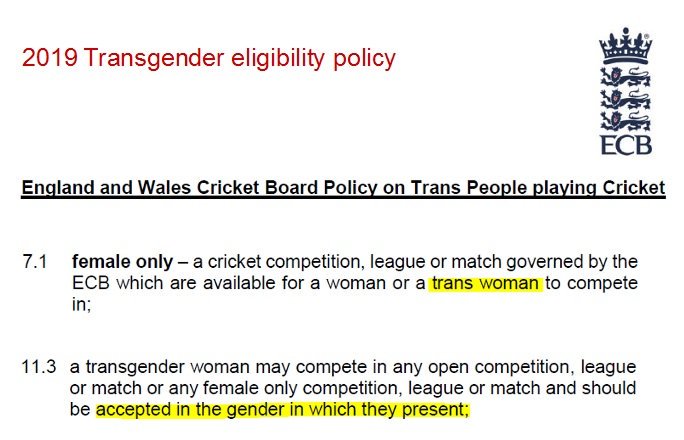
    Fair Play for Women on Twitter points out that it’s not just Australian cricket.

    We’ve all been stunned at the audacity of Australian Cricket opening up the women’s game to males …. but the English Cricket Board @ECB_cricket has been doing exactly the same.

    https://pulse-static-files.s3.amazonaws.com/ecb/document/2019/04/26/3bb659af-9a7d-4ffa-810d-7fae32959ee6/Non-First-Class-ECB-Regulations-Transgender-2019.pdf

    Image

    Bam, just like that.

    7.1 female only – a cricket competition, league or match governed by the ECB which are available for a woman or a trans woman to compete in;

    So not “female only” AT ALL but female plus whatever male feels like claiming to be a trans woman for the purposes of playing cricket against women.

    11.3 a trans woman may compete in any open competition, league or match or any female only competition, league or match and should be accepted in the gender in which they present;

    So not “female only” AT ALL but female plus whatever male feels like forcing himself on women.

    They should just come right out and say they’re not going to have female only any more.