
A vast new study finds there are 70 percent fewer wild animals sharing the earth with us than there were in 1970.
Ouch.
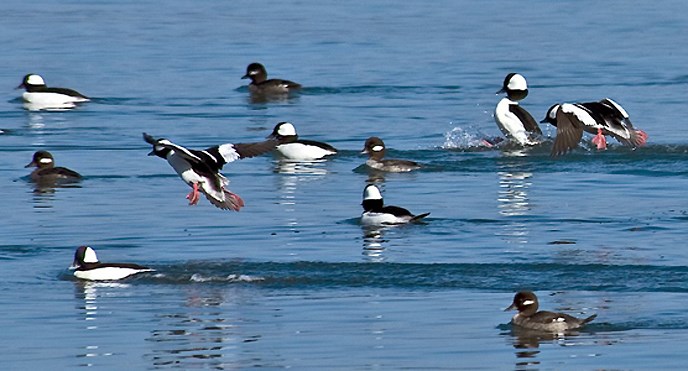
I notice a lot of missing wild animals even here in big city Seattle. It used to be commonplace to see mergansers and coots and buffleheads on lakes and ponds here, lots of them, and now I walk along Lake Washington and see none at all. None at all. Sometimes I see one or two, but not often. And swallows. Swallows used to come back in the spring, and you’d see a lot of them. Now? Zip. None. Very occasionally one lone pair, but that’s all. They’re just gone.
Comments
11 responses to “They’re gone”
An ecosystem can have many species, each represented by few individuals, a few species, each represented by many species, or gradations in between. What it cannot have is many species each represented by many individuals.
What we are headed for is a world where our species is at the top of a maximum number of food chains and food pyramids, with side like-it-or-not side deals done with our domesticated animals and plants of protection from predators and pests in return for their meat and other body components at a time chosen by us.
Arguably an unstable arrangement in need of constant rescue and course correction.
Amendment to my comment @#1:
An ecosystem can have many species, each represented by few individuals, a few species, each represented by many individuals, or gradations in between. What it cannot have is many species each represented by many individuals.
What we are headed for is a world where our species is at the top of a maximum number of food chains and food pyramids, with side like-it-or-not side deals done with our domesticated animals and plants of protection from predators and pests in return for their meat and other body components at a time chosen by us.
Arguably an unstable arrangement in need of constant rescue and course correction.
Here where we are in Japan, on the outskirts of Tokyo, in what, 40 years ago, was an area with a fair bit of agricultural land (with choruses of frogs) and nature left, the number of birds – swallows, wintering waterfowl on the Tama River – and wild animals has dwindled dramatically over the years. It is deeply depressing, and to be honest I shall be glad to leave this world before too long. I feel deeply sorry for the younger generations.
The lust for short term profit, combined with industrial technology, and a growing human population has proven to be a recipe for disaster.
I remember being stunned by this xkcd comic about Earth’s Land Mammals by Weight:
https://xkcd.com/1338/
For a little while longer…
Everybody must eat MUCH less meat. And, considering how much agricultural land is devoted to corn used both to force-feed pigs and cows and to produce corn syrup for junk food, we could be a lot more efficient with land-use by cutting down on corn.
Re-wild the areas dedicated to producing all that meat and corn.
I’m just spit-balling here.
A number of perfect storms are approaching inside the next 50 years: We need to:
1. stop dining on fossil fuel via modern agriculture and its use for synthetic fertiliser.
2. get the CO2 level in the atmosphere down as close as possible to pre-industrial levels, as reflected in sea-level rise.
3. reduce the Gini coefficients of all nations as far as possible. 0 = perfect equality; 100 = perfect inequality.
4. stop using fossil carbon as fuel, and keep it for a source of plastics etc. (We have about 1,000 years’ worth at current rates of consumption. So solar, not coalar.)
5. promote biospheric recovery rather than decline. (Nature bats last.)
6. Etc.
https://sealevel.colorado.edu/
https://www.indexmundi.com/facts/indicators/SI.POV.GINI/rankings
I remember even as recently as 15 years ago my husband and I would sit on the porch watching fireflies. They were abundant. Bullfrogs croaking in the distance, and crickets chirping somewhere unseen…and we live in the city. A small city, to be sure, but a city. Now what I see is squirrels, domesticated pets, and the roar of automobiles.
I’ve been talking about this a long time. People want to focus solely on global warming, and I’ve had this argument – what good is a world where we’ve solved global warming and there are no animals left? We need to focus on the big picture, but we are not good at that. All of them are part of the same interlocked problem. The biggest losses of species are caused by loss of habitat. That loss of habitat comes with increased emissions, plus the urban heat island effect.
The species that are still abundant seem to be those that like living with humans…and other than a few domesticated animals, most of those we don’t like. Dandelions, rats, racoons, and other species that can feed off our detritus.
Crows. There are still lots of crows around. And robins, and Steller’s jays, and an occasional blue jay, and gulls because this is a port city. Pigeons. Bald eagles are thriving, ironically.
@iknklast – Sackett V EPA is a case that could really fuck things up even worse:
In Sackett v. EPA, the U.S. Supreme Court Could Soon Gut the Clean Water Act at Polluters’ Request
People don’t get how important wetlands are for cleaning water, and for drainage. One of the reasons that in 1997 the uppper midwest Red River Flood was so catastrophic was the wetlands have been converted to cropland and when the snow melted, it rushed towards the river faster than the river could carry it north due to it being frozen (it runs north) up in Manitoba.
Wetlands aren’t swamps, they are flowage systems and often they run under solid ground so people aren’t aware of them without a geological survey. But, the precedents set by EPA v Reserve Mining Co (1973) are at risk under this court. We are swimming against the tide here.
[…] a comment by iknklast on They’re […]