Tag: Charlie Hebdo

  • The outrage from the majority of the writing community has been unequivocal

    The historian Amanda Foreman rebukes the calumnies against Charlie in a terrific op-ed on Charlie at the Wall Street Journal.

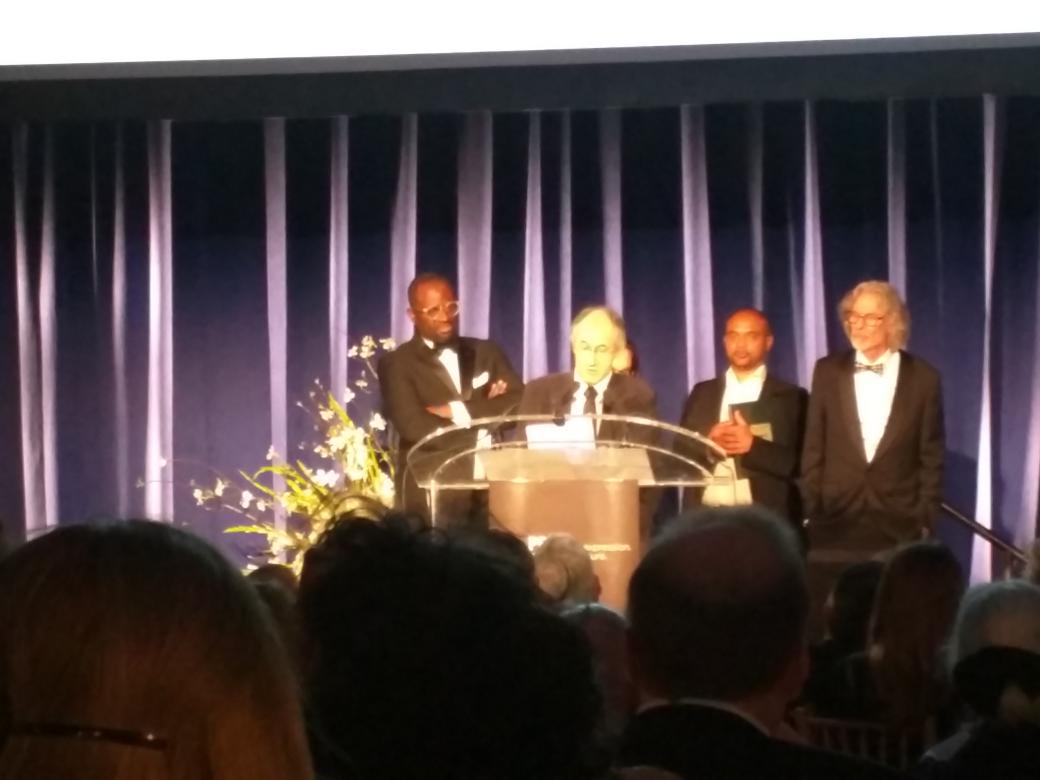
    The heartfelt standing ovation for Gerard Biard and Jean-Baptiste Thoret—who accepted the Freedom of Expression Courage award on behalf of the magazine—had its own eloquence. Unusually, the many writers in the room didn’t need to say anything to make themselves heard. Simply being at the dinner was a statement, a Rubicon moment for those who believe that universal human rights is a cause worth dying for. Just as boycotting the awards has become the rallying event for those who believe that it comes second to other considerations.

    I don’t much want to die for any cause, but if I had to that would be the one I would choose. Universal human rights, not local ones, not faith-based ones, not communal ones.

    In the days since 204 writers including Peter Carey, Joyce Carol Oates and Francine Prose—roughly 5% of the membership—signed a letter outlining their objections to the award, criticism of their stance has been unending. From the liberal Nation to the conservative Weekly Standard, the outrage from the majority of the writing community has been unequivocal: Freedom of speech, protected by the First Amendment, is a nonnegotiable right.

    After the boycott began, it was met with a thorough demolishing of the claims by its supporters, especially the charge that Charlie Hebdo is racist. Whether through ignorance or malice, this self-appointed committee of public safety insinuated that the magazine’s writers had provoked their own murder by attacking Islam in general, and victimizing French Muslims in particular. Charlie Hebdo’s brand of humor, we were told, “intended to cause further humiliation and suffering.”

    That calumny has now been exposed as a lie in point-by-point repudiations by some of the most respected voices in France, including the author Bernard-Henri Lévy and Dominique Sopo, the head of SOS-Racisme. The facts are there for all to see, such as: the Hebdo staffers were murdered while planning a conference on antiracism, and only seven of 523 covers for the magazine in the past decade touched on Islam. The protesters can no longer peddle the libel that Charlie Hebdo is a modern-day equivalent of a Nazi propaganda sheet, as several have, including Deborah Eisenberg, whose letter to PEN asked whether it would next be “giving the award retroactively to Julius Streicher’s Der Stürmer.”

    She goes on to tell an important story about the Dubrovnik conference, something I don’t recall being aware of before.

    While denouncing the PEN boycott, Mr. Lévy referred to the “deplorable Congress of Dubrovnik of 1933, at which the predecessors of Peter Carey refused to take a position against the book-burnings in Germany.” The Dubrovnik conference, in what was then Yugoslavia, took place on May 10, 82 years ago.

    The PEN president at the time, H.G. Wells, tried to maintain neutrality between those who wanted to speak out against Nazism and those who argued that politics had no place in a literary organization. His aim was defeated by the sole American delegate, Henry Seidel Canby, who forced through a resolution crafted by PEN America that restated PEN’s core mission as an advocacy organization.

    Because of Canby’s courageous stand, the exiled German playwright Ernst Toller was able to make his own speech the following day—an impassioned plea on behalf of writers suffering Nazi persecution. The German delegation and others walked out. Toller’s speech persuaded the remaining delegates that the organization had to remold itself into the one we know today.

    And who are the Nazi persecutors today? Not the staff of Charlie Hebdo, that’s for damn sure.

    Like its 1933 counterpart, PEN today has decided it will not be neutral in the battle between free speech and the assassin’s veto. It may be that some members will never be fully comfortable with this decision. They should be let go without heartache or second-guessing. There are plenty of other organizations for which the dictates of personal taste, sensitivity and interpretation carry the day.

    For those who believe in freedom of expression, the moment has come to make the choice between its defense or abandonment against a murderous movement that believes democratic values are subordinate to religious sensibilities. At the end of the evening on Tuesday, I spoke with Jean-Baptiste Thoret, Charlie Hebdo’s film critic. “There are just two options facing us all,” he said, “and we have to take a side.”

    I’ve taken mine.

  • Myths about Charlie Hebdo

    Jeffrey Goldberg at the Atlantic writes about Charlie, with some useful information.

    A subsidiary myth has grown up around Charlie Hebdo: that anti-Jewish hostility in its pages was forbidden. This false belief is offered as proof of the magazine’s “Islamophobic” tendencies (about the term “Islamophobia,” please read my interview with the prime minister of France, Manuel Valls).

    This myth arose in part because of a controversy concerning the cartoonist known as Siné, who was fired from the magazine in 2008 after implying that the son of former French President Nicolas Sarkozy would “go a long way in life” after converting to Judaism. Critics of Charlie Hebdo point to this incident as proof thatCharlie Hebdo maintained a double standard when it came to Muslims: “Even Charlie Hebdo once fired a writer for not retracting an anti-Semitic column,” Garry Trudeau stated in his now-infamous anti-free-speech speech at the George Polk Awards ceremony in April. “Apparently he crossed some red line that was in place for one minority but not another.”

    I will put aside for now Trudeau’s dark insinuation about Jewish power—one that he embedded in a discussion concerning an extended terrorist siege that ended with the slaughter of four Jews of North African origin at a kosher supermarket—an example of Paris-style “Jewish privilege,” I suppose you could say.

    Siné, of course, was not ridiculing a Jewish idea. Instead, he was deploying an anti-Jewish canard—that Jews maintain a protective cabal designed to advance each other’s interests—against an individual, living person. His comment was not a theological critique, but a libelous accusation. Siné was asked by the magazine’s editor to apologize to Sarkozy’s son, but he refused and was fired. (Siné, by the way, has described himself as a Jew-hater. “Yes, I am anti-Semitic and I am not scared to admit it,” he once said. “I want all Jews to live in fear, unless they are pro-Palestinian. Let them die.”)

    Ew.

    Now there’s an example of speech that I would not like to see get an award from PEN. That right there – “I want all Jews to live in fear.” That’s a horrific thing to say.

    Another myth: Charlie Hebdo is interested in advancing a “narrative” of “white privilege,” and therefore specializes in ridiculing powerless people.

    The novelist Francine Prose, one of the writers protesting the PEN award to Charlie Hebdo, wrote recently that, “The narrative of the Charlie Hebdo murders—white Europeans killed in their offices by Muslim extremists—is one that feeds neatly into the cultural prejudices that have allowed our government to make so many disastrous mistakes in the Middle East.”

    Prose’s coldness toward the victims of violence matches Trudeau’s. The 12 people killed at Charlie Hebdo were not extras in a George W. Bush-scripted imperialist narrative. They were human beings who were murdered because they offended the beliefs of theocratic fascists. It is not a narrative calumny to assert that white Europeans were killed by Muslim extremists at Charlie Hebdo’s offices on January 7. It is a sad fact. (It is also a sad fact that one of the Charlie Hebdo editorial staffers killed that day was a French citizen of Algerian extraction named Mustapha Ourrad. But I suppose acknowledging this fact would interfere with Francine Prose’s own narrative of majoritarian perfidy.)

    And her own right-on-ness.

    The power dynamic between the jihadists Said and Cherif Kouachi and the cartoonists of Charlie Hebdo was quite unequal, but it did not tilt in the direction Trudeau believes it tilted. It was not the Charlie Hebdo cartoonists who murdered the Kouachi brothers. Trudeau, and the critics of the PEN American Center and Charlie Hebdo, might not realize that they are captive of another, related myth: that terrorism is a weapon of the marginalized and the weak. Terrorism is most definitely not a weapon of the weak; it is a weapon used against the weak. The cartoonists and writers at Charlie Hebdo never stood a chance against their killers.

    It could be both. Terrorists do sometimes fight on the side of “the weak.” But when they have body armor and big guns and their targets have neither, yes, they definitely have armor and gun privilege.

    One more myth concerns the way in which the Left understands Islamism. No fundamentalist interpretation of any religion deserves the protection and sympathy of progressives. Islamists—adherents of a politicized, radical strain of Islam—are misogynistic, homophobic, and anti-enlightenment, and possess no tolerance at all for members of religious groups whose beliefs conflict with their own. These are traits one traditionally associates with the far-right, but some on the left are happy to support Islamists—even Islamist terror groups—simply because they stand in opposition to the West. (Judith Butler, the Berkeley comparative-literature professor, famously described Hamas and Hezbollah as “social movements that are progressive, that are on the left, that are part of a global left.”)

    And there’s George Galloway. I hope he’s losing right now. The polls close in an hour and a half; I hope he loses.

    In her anti-Charlie Hebdo op-ed, Francine Prose wrote, “Our job, in presenting an award, is to honor writers and journalists who are saying things that need to be said, who are working actively to tell us the truth about the world in which we live. That is important work that requires perseverance and courage. And this is not quite the same as drawing crude caricatures and mocking religion.”

    I hope that someone, someday, will explain to Francine Prose the work of Voltaire and Spinoza. I also hope that Garry Trudeau will one day understand that it is an act of bravery to write in opposition to religious fundamentalism in the face of fatal violence. And I’m glad that the PEN American Center has not capitulated under pressure.

    I actually hope both of them learn better right now. I like the work of both of them, and have for a long time, and I would like to see them redeem themselves.

  • A conversation about the challenges to free expression

    Courtesy of NYU’s Arthur L. Carter Journalism Institute, the video of the forum on free expression and Charlie Hebdo on Tuesday morning.

    Join us for a conversation about the challenges to free expression in France and Europe, the role of satire in open societies, the controversies that have surrounded Charlie Hebdo, and the tensions between respect for religious differences and protections for freedom of expression.

    Charlie Hebdo’s recently appointed editor-in-chief, Gérard Biard, and its film critic, Jean-Baptiste Thoret, are visiting the United States for the first time since the attack on Charlie Hebdo’s office in Paris, which killed eight of their co-workers and four others. On the evening of Tuesday, May 5, they will receive the PEN/Toni and James C. Goodale Free Expression Courage Award at the PEN American Center’s annual Literary Gala in New York.

    Panelists include the director of NYU’s Institute of French Studies, Ed BerensonCharlie Hebdo editor-in-chief Gérard Biard; PEN Executive DirectorSuzanne Nossel; and Charlie Hebdo film critic Jean-Baptiste Thoret. Journalist Maggy Donaldson will moderate.

    Presented by the PEN American Center and NYU’s Arthur L. Carter Journalism Institute.

    H/t Salty Current

  • “Charlie Hebdo’s cartoons of the Prophet must be seen as being intended to cause further humiliation and suffering”

    In light of the refusal of the anti-Charlie Hebdo protesters to discuss or defend their claims about Charlie, let’s take another look at those claims. Let’s consider what they’re leaving out there, unexplained and unargued.

    The letter.

    • An expression of views, however disagreeable, is certainly not to be answered by violence or murder.
    • However, there is a critical difference between staunchly supporting
      expression that violates the acceptable, and enthusiastically rewarding
      such expression.
    • To the section of the French population that is already marginalized,
      embattled, and victimized, a population that is shaped by the legacy of
      France’s various colonial enterprises, and that contains a large percentage
      of devout Muslims, Charlie Hebdo’s cartoons of the Prophet must be seen as
      being intended to cause further humiliation and suffering.
    • by bestowing the Toni and James C. Goodale Freedom of Expression Courage Award on Charlie Hebdo, PEN is not simply conveying support for freedom of expression, but also valorizing selectively offensive material: material that intensifies the anti-Islamic,
      anti-Maghreb, anti-Arab sentiments already prevalent in the Western world.
    • PEN America has chosen to honor the work and mission of Charlie Hebdo above
      those who not only exemplify the principles of free expression, but whose
      courage, even when provocative or discomfiting, has also been fastidiously
      exercised for the good of humanity.

    Francine Prose in the Guardian.

    • I wondered what I would do when the crowd around me rose to its feet to applaud an award being given – in my name – to what I felt was an inappropriate recipient.
    • I believe in the indivisibility of the right to free speech, regardless of what – however racist, blasphemous, or in any way disagreeable – is being said.
    • As a friend wrote me: the First Amendment guarantees the right of the neo-Nazis to march in Skokie, Illinois, but we don’t give them an award.
    • Our job, in presenting an award, is to honor writers and journalists who are saying things that need to be said, who are working actively to tell us the truth about the world in which we live. That is important work that requires perseverance and courage. And this is not quite the same as drawing crude caricatures and mocking religion.
    • The narrative of the Charlie Hebdo murders – white Europeans killed in their offices by Muslim extremists – is one that feeds neatly into the cultural prejudices that have allowed our government to make so many disastrous mistakes in the Middle East.

    That’s their “narrative” and they’re sticking to it.

  • They said they did not want to bother “the recently bereaved”

    Boris Kachka gives a rather sneery account of the PEN gala.

    Perhaps unsurprisingly, the two people most sanguine about the ruckus were the honorees, who’ve seen worse. “I’m surrounded by cops, and it’s no problem,” said Gérard Biard, the French satirical paper’s current editor-in-chief. “I began to get used to it,” he added — as he has to the notion that Hebdo traffics in needlessly provocative racist caricatures. “I would like to remind the protesters that the first victims of Islamism are Muslim. We don’t attack Muslims, we defend them. Do they?”

    One of the aspects of the issue that the protesters are overlooking is the fact that some Muslims emigrate from majority-Muslim countries because they don’t want to live lives dominated by Islam. Some Muslims leave such countries because they want to escape Islamism.

    His colleague Jean-Baptiste Thoret, who was late to the editorial meeting at which eight Hebdo staff members were killed in January, regretted that the missing hosts — including Peter Carey, Michael Ondaatje, Rachel Kushner, and Teju Cole — had skipped a morning PEN panel where he’d appeared. (They’d declined in an email, saying they did not want to bother “the recently bereaved.”)

    Oh, please. That’s insulting, if you like.

    Other PEN hosts — especially Art Spiegelman and several other cartoonists he’d drafted to replace the protesters at tables — gave less ground on the ten-day-old debate. “I think of them as the Sanctimonious Six,” said Spiegelman, wearing a Nancy comic tie, of the absent hosts. He detected in them a note of anti-cartoonist bias, especially in the way criticism over the last few days had integrated the Dallas Muhammad-drawing contest that provoked a shooting. “Some of them were derogatory for the medium, talking about them as by nature vulgar,” he said. “Sure, Charlie Hebdo’s drawings are often vulgar when you think of Muhammad with a crescent moon up his ass, but the ideas behind it are rather sophisticated. A lot of the criticism seemed to blur the distinctions between Pamela Geller’s organization,” the Muhammad-drawing contest group, “and Charlie Hebdo, which has been lauded as an anti-racist organization by SOS Racisme” — a French anti-racism NGO.

    Quite. The protesters talk as if Charlie Hebdo is allied with and comparable to Pam Geller, which is a crude mistake – yet they refuse to learn otherwise.

    The defense offered stood on three legs. SOS Racisme tackled the first one, arguing that the work of Charlie Hebdo was not racist. “We honor their antiracist commitment, which has been consistent throughout their existence,” said Sopo. The previous week’s “polemic” was based on a fundamental “misunderstanding of what Charlie Hebdo means in France. I think it’s very important that we do not kill those who died a second time by raising a polemic.”

    The second leg was a defense of secularism. “Secularism is not a bad word,” Biard said in his speech, subtitles flashing behind him, making it feel only more like a high-school lesson on laicité. “Nor is it a French cultural obsession, like smelly cheese or flabby presidents. It’s one of the many conditions for democracy. Secularism protects our freedom of conscience, which is both the right to believe and the right not to believe.”

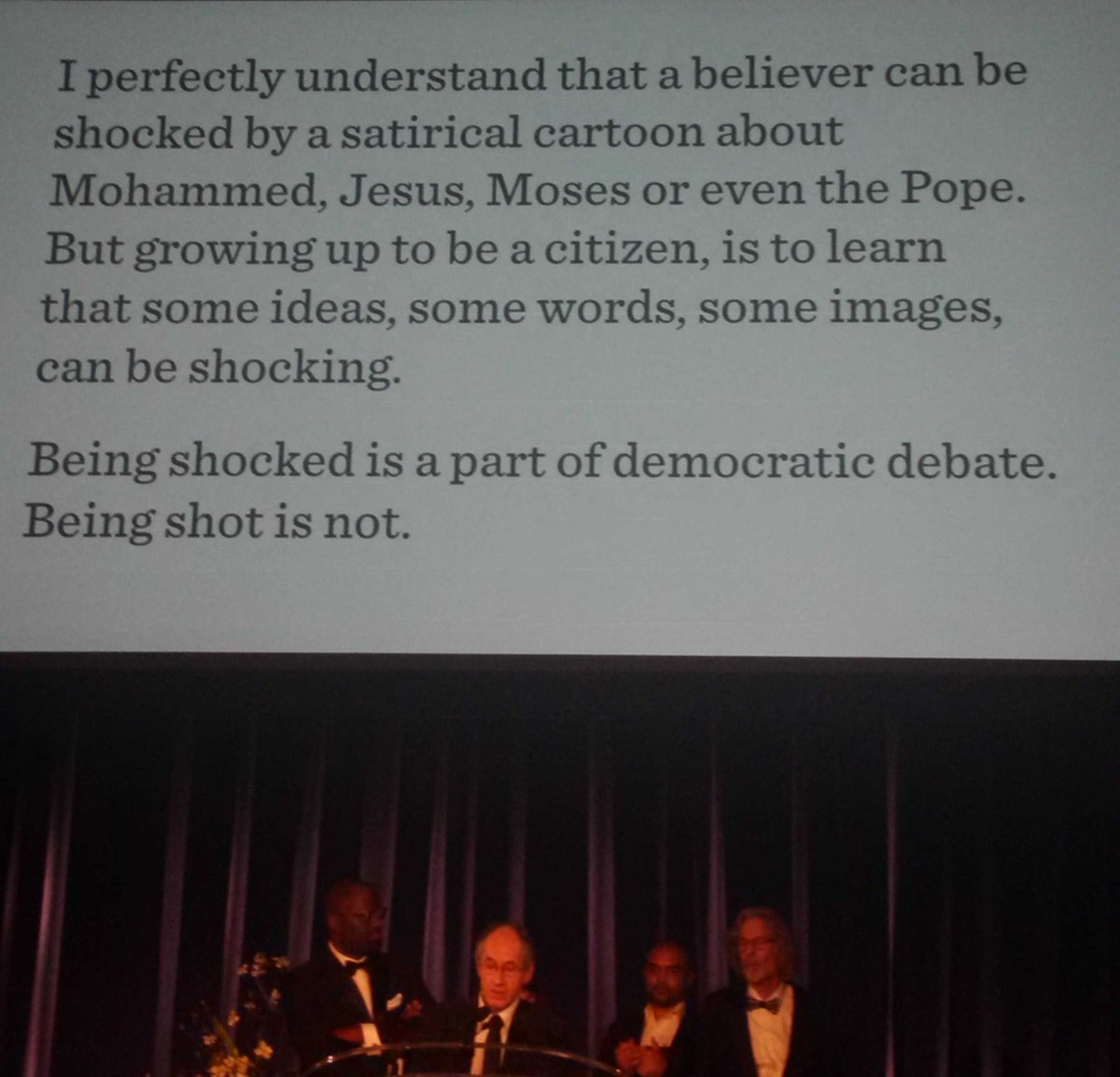
    New Yorker cartoon editor Robert Mankoff made the final point. “The attack was targeted on cartoonists, and that wasn’t an accident,” he said. “I do feel that cartoonists, humorists, satirists, and jokers are the marginalized group in the defense of freedom of expression. Often, humor is the second-class citizen in the defense, and I want to say that it’s nice that Charlie Hebdo is up here in the first-class cabin.” Then he named the one thing his cartoons and Hebdo’s have in common: “Not everyone gets the joke.” It echoed Biard’s closing line, like a flashy defense attorney’s last flourish: “Being shocked is a part of democratic debate. Being shot is not.”

    Well you can call it flashy and a flourish all you like, but it’s true and it’s about a thing that truly did happen. I myself don’t think it’s a subject that requires an ironic treatment.

  • Deference to “personal” religion even as religion colonizes public life

    Salty Current went to the PEN forum on Charlie Hebdo and challenges to free expression yesterday, and reports on it at her blog.

    What she says about the difference between French secularism and US “secularism” is exceptionally useful. Bolding mine.

    The conversation covered important differences between US and French law and culture, specifically between secularism as practiced in the US and laïcité in France and between US and French laws surrounding freedom of expression. Critics of the magazine in the US often seem to ignore the difference between US secularism (or “secularism”) and French laïcité. Laïcité as they described goes beyond the separation of church and state – it understands the public sphere and political discourse as a common space in which religion has no role or status, and outside of which religion (for some) is practiced, and respected, privately. In this context, religion is seen as intruding on the public sphere and publicly mocking religious iconography and practices as political targets is acceptable. This can be difficult to understand here in the US because our system is so different in theory and in practice. The US system wasn’t really discussed at the forum, but as I’ve argued many times it’s based on a bogus sort of compromise in which institutionalized religion is (in theory) kept separate from the state, but religious claims and identities suffuse political discourse and public policy, all while people are expected to refrain from criticizing or mocking religion because it’s an allegedly personal and emotional matter. Whatever the problems with laïcité in practice (and Berenson hinted at some, although unfortunately there wasn’t time to return to them), the US system with its tradition and practice of deference to “personal” religion even as religion colonizes public life is ridiculous and anti-democratic.

    Thatty that that.

    Read it all; it’s outstanding.

  • When Muslim students complained about posters

    There was a panel on free speech and satire in the wake of the Charlie Hebdo murders at the University of Minnesota on January 29th. There was also, we now learn from Inside Higher Ed, a debate on the debate later on.

    When Muslim students complained about posters that promoted the event, the university investigated their concerns and issued a report that questioned the judgment of those who signed off on the posters. And the university sent an email that some interpreted as an order to remove the posters, although the university disputes this.

    The discussion raises questions about how colleges and universities should balance their commitments to academic freedom and free speech with the cultural sensitivities of students and others involved in campus life. And like the recent PEN award protests over a planned tribute to Charlie Hebdo, it’s also a reminder of how controversial the magazine and what it stands for remain, and how the attack continues to reverberate among thinkers across continents.

    Or it’s a reminder of what an artificial and absurd pseudo-controversy there is over Charlie Hebdo and how eager some benighted people are to create controversy where no controversy should be.

    Hoping to provide a space for dialogue, by the end of the month several professors had organized a panel called “Can One Laugh at Everything? Satire and Free Speech After Charlie.”

    The panel included Sack, who reflected on being a cartoonist, and several Minnesota professors. Anthony Winer, a professor of law, offered a comparative study of free speech laws. Jane E. Kirtley, the Silha Professor of Media Ethics and Law and director of the Center for the Study of Media Ethics and Law, delivered a talk called, “As Welcome as a Bee Sting: Why We Must Protect ‘Outrageous’ Speech,” while William Beeman, professor and chair of anthropology, talked about figurative representations in the Islamic tradition — including lesser-known historical depictions of Muhammad. Most observant Muslims now consider any kind of physical representation of Muhammad off-limits.

    Off-limits where? To whom? According to whom? When? Why?

    Observant Muslims can go right ahead and consider any kind of physical representation of Muhammad off-limits to themselves, if they want to, but they do not have the right to impose that silly and childish rule on anyone else. People can decide to swear off dancing if they want to, but they can’t decide that for the rest of us. People can take vows of celibacy if they like, but they can’t take vows of celibacy for other people.

    The organizers advertised the panel with a flyer featuring the cover of the Charlie Hebdo edition published immediately after the terrorist attack. In contrast to the magazine’s earlier, at times vulgar depictions of the prophet, the cover shows a bearded man with a turban — almost certainly intended to be but not explicitly labeled as Muhammad — shedding a single tear. The headline is “Tout est pardonné,” or “All is forgiven,” and the man is holding a sign that says, “Je Suis Charlie,” or “I Am Charlie,” a popular pro-magazine protest phrase following the attack. Over the image, the organizers put a red “censored” stamp-like image, which did not originally appear on the Charlie Hebdo cover.
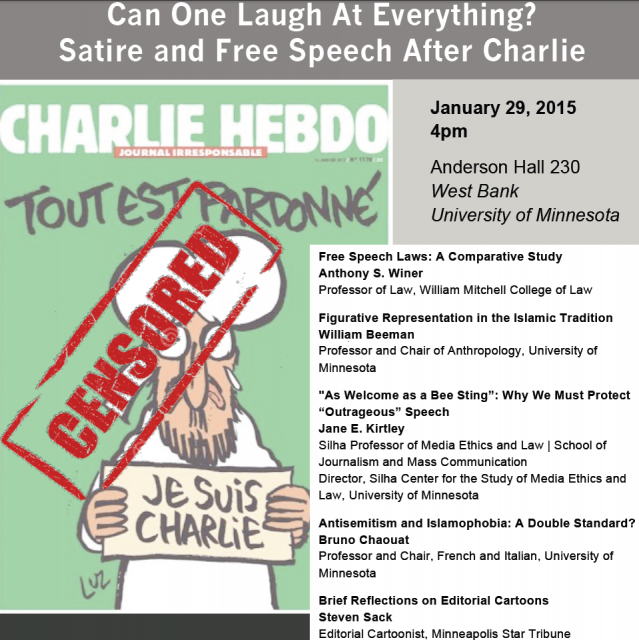
    They discussed the possible negative impact of publishing a picture of Muhammad on the flyer, given the prohibition against physical representations. But the organizers decided that doing so was appropriate for the event on free speech, according to a university account, and might also lead to more Muslim students attending. The flyer was published on the various unit sponsors’ websites and elsewhere on campus.

    I’m sorry to hear they even discussed it. I’m sorry Colleen Flaherty wrote “given the prohibition against physical representations” without questioning it. I’m sorry this is any kind of issue at all.

    Kirtley, the media law scholar, described the event as standing room only, with “lively discussion” that was “not remotely hostile — there was no one complaining and there were quite a few students who self-identified as Muslim.” Audience members and panelists continued to talk informally long after the scheduled end of the event.

    So panelists were surprised to learn weeks later that complaints had been filed with the university’s Office of Equal Opportunity and Affirmative Action. The complaints were targeted at Chaouat and Prell as organizers, and referred not so much to the event itself as the poster advertising it.

    According to a summary of the office’s investigation prepared for John Coleman, dean of the liberal arts, eight people — four students, a retired professor, an adjunct professor and two others from outside the university — contacted equal opportunity personnel to express concern that the flyer “featured a depiction of Muhammad, which they and many other Muslims consider blasphemous and/or insulting.”

    There’s the confusion again. It’s not “blasphemous” to anyone who doesn’t buy into the version of Islam that says it is. It’s not just objectively blasphemous, it’s blasphemous only to people who take a very narrow and self-important view of a particular religious taboo. And how is a depiction of Muhammad insulting? And, again, to whom?

    It’s all bullshit. It’s touchy, short-fuse, looking-for-grievances bullshit.

    Maybe what they really mean is that the poster reminds them of the Charlie Hebdo murders, and that makes them feel not very comfortable about some of their fellow-Muslims, and that’s an uncomfortable sensation. I can sympathize with that; I can imagine it would be. But the right response is not to try to punish people for reminding them.

    The fact that “Charlie Hebdo originally created the image of Muhammad added to the insult, because [the magazine] has previously printed cartoons deliberately mocking Muhammad, including some depicting Muhammad naked and in sexual poses,” the summary continues. “This led some complainants [to] conclude that the [college or cosponsoring academic units] and the professors involved in organizing and promoting the event do not care about Muslims on campus.”

    Oh yes? Well I conclude that the complainants don’t care about non-Muslims on campus and elsewhere, even the ones who were slaughtered in a Paris office. I conclude that they don’t even care about the Muslim editor and the Muslim cop who were murdered by the Kouachis.

    The office also received a petition signed by about 260 Muslim students, several staff members and about 45 people with no affiliation with the university. The petition says, in part, that the flyer is “very offensive” and has “violated our religious identity and hurt our deeply held religious affiliations for our beloved prophet (peace be upon him). Knowing that these caricatures hurt and are condemned by 1.75 billion Muslims in the world, the university should not have recirculated/reproduced them.”

    There speaks the totalizer. They don’t know that the cartoons hurt every single Muslim on earth. (Also 1.75 billion? The number does keep creeping upward.) They don’t know that every single Muslim on earth condemns the cartoons. They don’t know any of that, they’re just bullying. They want to make their religious taboos binding on the whole world. Well fuck that. It will require killing all of us, or killing most of us and enslaving the rest.

    Equal opportunity administrators conducted a formal investigation based on the complaint, including interviews with the event organizers. According the investigation summary, organizers “collectively reported that they chose to reprint the Charlie Hebdo image to express a commitment to the future of [the magazine] and to free speech generally, to condemn terror and to show Muhammad expressing love and compassion.” Moreover, organizers said, the image already had been published by news organizations worldwide. They also expressed a belief that “their dissemination of the flyer is protected speech under the First Amendment and principles of academic freedom.”

    Ultimately, the office determined that the poster did not violate the university’s antiharassment policy, which prohibits discrimination on the basis of religion. Factoring into the decision was the poster’s relevance to academic subjects and its general commentary on a matter of public concern.

    However, the office said in its summary for the dean, the poster had “significant negative repercussions.” And given the “large-scale” global protests against the image in question, “the organizers knew or should have known” that their decision to reprint the image “would offend, insult and alienate some not-insignificant proportion of the university’s Muslim community on the basis of their religious identity,” the office added. It said the hurt was heightened by the fact that the insulting speech came from those with “positional power” at Minnesota.

    But the office knows or should know that all people in “the university’s Muslim community” are free to refuse to be offended and insulted and alienated. It’s pretty insulting to assume that a significant proportion of them will be unable to see the matter that reasonably. It’s insulting to assume a large number of them are prickly babies.

    Equal opportunity administrators told Coleman that he had the “opportunity to lead in creating an inclusive and welcoming environment for Muslim students by adding your own speech to the dialogue advocating for civility and respect by [college] faculty.” The office recommended that Coleman communicate the college’s disapproval of the flyer and “otherwise use your leadership role to repair the damage that the flyer caused to the relationship between [the college] and Muslim students and community members.”

    They wanted the dean of liberal arts to issue a formal disapproval of the flyer, in order to soothe the neurotic religious outrage of an unknown number of Muslim students. That’s revolting.

    In a brief interview, Chaouat said he feared it was possible that “terror and terrorism actually work when people have a tendency to internalize the fear of retaliation and to self-censor. …This is something that’s happened in France after the January events — there’s been a lot of self-censorship in the aftermath of theCharlieHebdo attacks and I’m afraid we’re on the path here as well.”

    He added, “In the name of tolerance and acceptance and diversity, we’re actually lying to ourselves.”

    It would be vastly better to just say we’re scared. All this oily “concern” and hand-wringing and coddling is anti-intellectual and illiberal and sick-making.

  • “The very existence of Charlie Hebdo is a manifestation of gross privilege”

    The writer Monica Byrne presents us with an example of well-meaning but confused reasons for objecting to an award’s being given to Charlie Hebdo. The example is interesting because I keep finding the objections and protests under-explained and under-motivated, so I remain curious about what exactly the protesters think they’re protesting.

    She titles her post “The PENAmerican award I wish I could give tonight.” Ok, but wishing you could give a different award is nowhere near a reason for protesting one actually being given, especially under these particular circumstances.

    If you missed the news, here’s a summary: PENAmerican, an organization dedicated to free speech in arts and literature, is awarding French magazine Charlie Hebdo for “freedom of expression courage award,” for continuing to print after their entire editorial board was assassinated by extremists. Given the nature of Charlie Hebdo‘s content—and the conspicuous attention the assassinations received all over the world, even as journalists are killed daily by their own governments in the countries whose presidents showed up for “solidarity marches” in Paris—several writers (including Teju Cole and Rachel Kushner) resigned from being table hosts at the awards gala. Salman Rushdie excoriated them in The Guardian. Other writers have stepped up to take their places.

    “Given the nature of Charlie Hebdo‘s content” with no elaboration on what that nature is conveys the impression that Charlie Hebdo’s content is self-evidently pernicious in some way. The part about conspicuous attention just dangles there, unexplained. How is that any kind of explanation for what follows?

    However, she says she gets both sides.

    But here’s the thing I wish PENAmerican would get: claims to “freedom of expression” are a mark of privilege in places where oppressed populations are struggling merely to be allowed to live as themselves. For them, freedom of expression is a myth. The very existence of Charlie Hebdo is a manifestation of gross privilege bestowed on one segment of the French population and denied to another.

    Well of course it is (except for the word “bestowed”). That’s always the case. It’s a privilege to have readers, it’s a privilege to write or draw for a satirical publication, it’s a privilege to sell copies. But what follows from that? That we should just stop having any writers and cartoonists, magazines and newspapers and books? Should we all be restricted to Twitter?

    But you know what, even if we were all restricted to Twitter, privilege would still emerge, because some people would be more interesting or amusing than others.

    Obviously an award to writers or cartoonists is not an award to factory workers or domestics. Maybe awards are a bad idea in general. There are plenty of arguments for that idea; I’m pretty sure I’ve made some of them at various times, especially around the Oscars and the “Super Bowl.” But that’s not a reason to withdraw from one award out of many, especially when the people being awarded are survivors of a bloody massacre during an editorial meeting about an anti-racism campaign.

    It’s far easier, and far more lazy, to recognize The Organization That Had a Very High-Profile Awful Thing happen to them, than to, say, recognize that the entire Muslim population of France continues to live in the place they call home despite constant state-sanctioned hostility to their rights to life, livelihood, religion, and yes, freedom of expression.

    Is it? How much effort was it for Byrne to type that sentence? Not much.

    This is, frankly, just more Dear Muslima, albeit for very different reasons and aimed at a very different kind of people. It’s another fallacy of relative privation. There are all sorts of awful things happening all over the planet – Nepal, Nigeria, Syria, North Korea, take your pick – that PEN wasn’t talking about last night because it was talking about other things. But we are allowed to do different things, as our talents and interests suggest. We need writers and cartoonists too, along with aid workers and activists. And in any case Charlie Hebdo is on the side of the marginal and despised, so there’s even less reason to single them out for having privilege “bestowed” on them by fuck knows who.

  • They don’t want us to write and draw, we must write and draw

    Highlights from #PENgala and the award to Charlie.

    Neil Gaiman ‏@neilhimself 16 hours ago
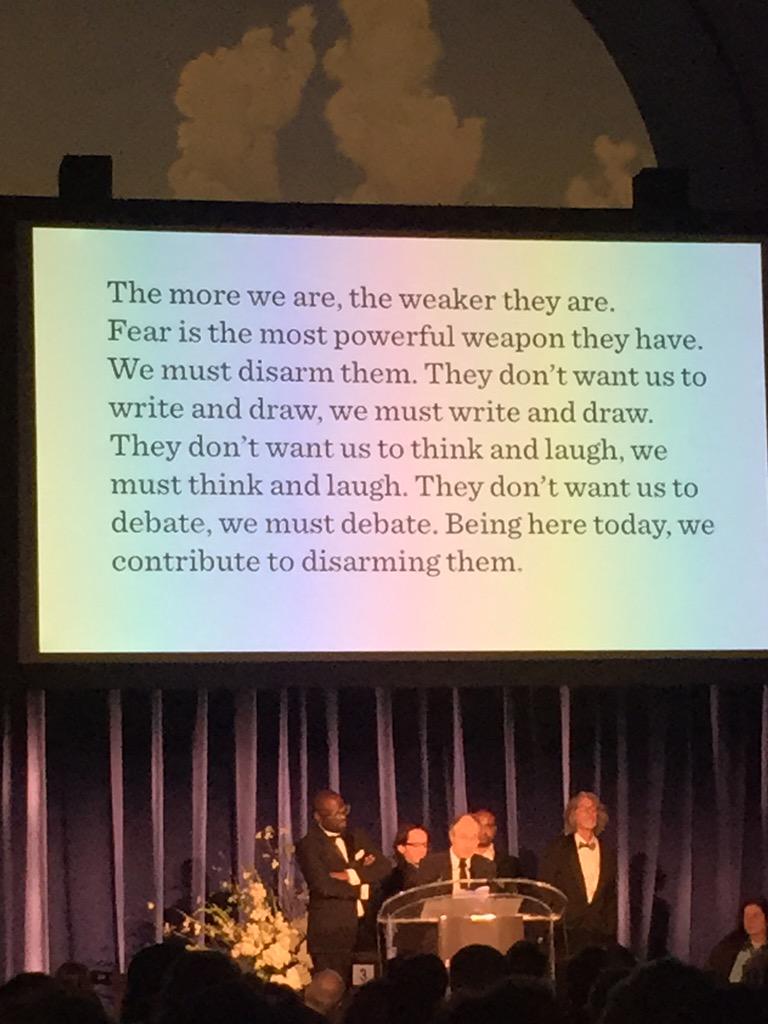
    Gerard Biard, Charlie Hebdo editor in chief, gets a standing ovation at the #PENgala. This was how his speech ended.

    Embedded image permalink

    BGrueskin ‏@BGrueskin 16 hours ago
    “Fear is the most powerful weapon they have. We must disarm them” #CharlieHebdo #PENgala

    Embedded image permalink

    Joel Simon @Joelcpj
    Moving to see #CharlieHebdo honored at #PENgala

     Embedded image permalink

  • Judicious use of “controversial” plus scare quotes

    The Guardian’s report on the PEN gala and the award to Charlie Hebdo is – predictably – much nastier than the Times’s. The Guardian throws them under the bus in the first sentence.

    Charlie Hebdo magazine received a controversial freedom of expression award from American PEN on Tuesday night despite the vocal opposition of many of its own high-profile members.

    That’s not only nasty, it’s bad writing – it sounds as if “members” of Charlie Hebdo vocally opposed the award. Hacks. But let’s focus on the nasty – they have to inform us instantly that the award is “controversial” and that many important people were vocally opposed. They have to load the dice, poison the well, frame the story.

    Accepting the award, Charlie Hebdo’s editor-in-chief Gerard Biard said that the magazine’s shocking and sometimes offensive content helped combat extremists who would limit free speech. “Fear is the most powerful weapon they have,” he said. “Being here tonight we contribute to disarming them.”

    Nicely done, Guardian.

    The decision to honour Charlie Hebdo has bitterly divided the literary community, with over 200 members of PEN signing a letter that said: “there is a critical difference between staunchly supporting expression that violates the acceptable, and enthusiastically rewarding such expression.”

    The magazine’s critics, including Peter Carey, Teju Cole and Rachel Kushner, who led a boycott of Tuesday’s event, said it that used racist stereotypes against the most marginalised members of French society, an accusation the editors reject.

    But the Guardian, it wants you to know, doesn’t.

    Biard and Congolese author Alain Mabanckou told the audience that Charlie Hebdo was and always had been “anti-racist”, a reply to the criticism that the magazine portrayed French racial and religious minorities in a stereotypical way. “Charlie Hebdo has fought all forms of racism since its inception,” Biard said.

    Mabanckou also argued that the magazine was simply received in France differently than in the US, and that misunderstandings had resulted from “cross-cultural exchanges: we all belong to one family and we’re all committed to freedom of expression”.

    I wonder what the scare-quotes on “anti-racist” are for. To nudge us into thinking they’re lying, perhaps?

    Mostly, gala guests defended the award on principle – a point that the dissenting writers also believe in, if not to the same degree. All agreed that writers, artists and people everywhere should be able to speak freely, even when that their words may shock or offend. PEN executive director Suzanne Nossel reiterated this point, and called for all members and writers to “move on together in defence of freedom of expression”.

    And the Guardian sincerely hopes that we will be left with the impression that the protesters were and are right, that Charlie Hebdo really is racist, and that the only reasonable defense of the award is based on the principle of free speech regardless of content.

  • Extraordinary people

    The Guardian tells us about the people replacing the boycotters at the PEN gala this evening.

    Now award-winning fantasy novelist Gaiman, acclaimed cartoonist Bechdel, Maus creator Spiegelman, Reading Lolita in Tehran author Azar Nafisi and American author and journalist George Packer have been named as new hosts at the event, which PEN confirmed would have heightened security. French-Congolese novelist Alain Mabanckou, meanwhile, will present the award to Jean-Baptiste Thoret, the Charlie Hebdo member of staff who arrived late to work on 7 January, missing the attack that killed 12 people.

    Mabanckou told the Guardian he had decided to present the award because “I’m a big reader of Charlie Hebdo, because I know that it’s not a racist magazine. I decided to do it in memory of all journalists and cartoonists who die because they have the courage to pursue their work. Finally, I decided to do it because among the members of Charlie Hebdo who were massacred in January 2015 was a friend of mine, the economist and journalist Bernard Maris, who was an extraordinary man.”

    From what I’ve been able to gather over the last four months, they were all pretty extraordinary.

    Gaiman tweeted:I’ll be hosting a table at the PEN event because it’s important.” He told the Associated Press in an email: “I was honoured to be invited to host a table. The Charlie Hebdo cartoonists are getting an award for courage: They continued putting out their magazine after the offices were firebombed, and the survivors have continued following the murders.”

    “They died for their beliefs. The award is for courage that transcends our like or dislike of them,” Nafisi tweeted this weekend. She also wrote: “PEN award to CH is recognition of the writers’ & artists’ rights to ‘disturb the peace,’ regardless of the price”.

    If writers and artists don’t disturb the peace, who will? I’m serious. Other people have other jobs to do, they don’t have time to disturb the peace, their bosses don’t want them to disturb the peace.

    Other writers including Paul Auster, Siri Hustvedt, Simon Schama, Richard Ford and Sara Paretsky have also offered their support to PEN. The novelist Salman Rushdie, meanwhile, has been a particularly outspoken supporter of PEN’s decision to honour Charlie Hebdo, writing in a letter to the free speech organisation that by withdrawing, the six authors had “made themselves the fellow travellers” of “fanatical Islam, which is highly organised, well funded, and which seeks to terrify us all, Muslims as well as non-Muslims, into a cowed silence”.

    And who can dispute him?

  • Guest post: By pushing an almost totalitarian narrative of white guilt

    Originally a comment by veil_of_ignorance on A new way to weasel.

    Two things:

    (1) It was indeed absurd and cynical how Western governments (and their MENA allies including the KSA) have exploited the CH massacre for empty lip service to free speech. However, this is a common phenomenon which is not limited to CH. We see it anytime when the political agenda allows it: from Raif over Pussy Riot to Liu Xiaobo. This does not mean that those people do not deserve to be honored or are some kind of neoliberal US-imperialist fifth column. Or to inverse the argument: the fact that Edward Snowden is now best friends with Putin – not due to the latter’s universal commitment to free speech but for obvious political reasons – doesn’t mean that Snowden should be accused of enabling Russian, neo-Stalinist nationalism and conservatism.

    (2) “By choosing to honor Charlie Hebdo, the victim of Islamic radicals, rather than any of the many worthy dissidents they could have chosen, people like Julian Assange and Edward Snowden, truly courageous people whose actions and words have placed them at odds with the powerful western nations of the world”. Since Furst likes to speak about narratives, I will provide a counter-narrative: What happened to CH doesn’t really involve American white liberals; however, it involves many progressive people in Muslim majority countries and the Muslim diaspora who are increasingly silenced, marginalized and endangered by the growth of Islamic fundamentalism. This is the reason why – while the white liberal American press tried to play white guilt Olympics – there generally was a lot of solidarity from the left-wing and liberal press in the MENA region, which realized that what happened to CH is also currently happening to them (Zineb El Rhazoui wrote interesting things about this topic and the fact that CH allowed francophone MENA authors to publish things which they could not publish in their home countries). By bringing in Assange and Snowden in contrast, the American liberal tries to make everything about them and their struggles again.

    I might go out on a limb, but I think that what we see in the whole CH debate is almost hegemonic white guilt: the American white liberal press holds a lot of power when it comes to influencing the international sociopolitical discourse. And by pushing an almost totalitarian narrative of white guilt – a narrative which vastly overstates the West’s power in today’s geopolitical constellation, which denies the agency of non-Western actors, which essentializes universal social problems (e.g. the role of women in society) to the West and romanticizes non-Western cultures (= a variety of orientalism which tends to be ignored) – it basically suffocates social dissent from the Global South.

  • A room half full of the self-righteously misinformed

    From one of the worst piece on Charlie Hebdo and PEN to one of the best: Michael Moynihan at the Daily Beast.

    On January 7, Jean-Baptiste Thoret was ambling toward the office, late for an editorial meeting—he’s a French film critic, after all—when 12 of his colleagues at the satirical newspaper Charlie Hebdo were being cut to ribbons by AK-47 fire. A fraternal team of semi-illiterate religious fanatics, Chérif and Saïd Kouachi, both Paris-born, casually returned to their getaway car, congratulating themselves for having avenged their aggrieved prophet. As a digestif, an accomplice was across town, preparing to murder Jewish shoppers at a kosher supermarket.

    It helps to know how to write, doesn’t it, particularly on this subject. It’s striking how much of the writing of the antis has been leaden and wit-free and clunky, even from people who ordinarily do know how to write. It’s as if the style is forced to match the thought: both must be equally talentless, the way two horses pulling a carriage have to pace together.

    Charlie Hebdo would seem a rather obvious choice for a prize celebrating journalistic courage, considering the newspaper was firebombed  in 2011 for producing cartoons satirizing militant Islam, lived with a heavy—but not heavy enough—security presence, and continued to raise a middle finger to those who threatened its journalists with death. But the award was an obvious choice that annoyed more than 200 PEN members—including Eric Bogosian, Wallace Shawn, Junot Diaz, and Peter Carey—who responded to the honor with a campaign of defamation against the dead.

    You’d think it would catch in their throats, wouldn’t you. You’d think they would shiver and stop and re-think their positions. You’d think they would quail at giving political support to people who murder cartoonists and Jewish supermarket-shoppers.

    Charlie Hebdo—scourge of the post-fascist political party Front National, enemy of Papists, cheerful anti-racist activists, fellow travelers of the French Communist Party, staunch agitators for Palestine—has been accused of racism and employing crude and offensive satire to “punch down” at an aggrieved minority.

    Six impossible things before breakfast.

    Two days after the murders, under the crass headline “Unmournable Bodies,” The New Yorker’s Teju Cole provided a confused exegesis on French satire, a subject he has previously avoided discussing.Charlie Hebdo, he wrote, was possessed of a “bullyingly racist agenda” and traded in “violently racist” images.

    I couldn’t even read that thing in January. I took a look, I cringed, and I couldn’t stand to read it.

    Elsewhere, the #JeSuisCharlie brigades were admonished for affiliating with an anti-Arab magazine whose “staff was white,” a point not contested by editor Moustapha Ourrad because he had annoyingly just been murdered by religious psychopaths. Nor did Zineb El Rhazoui protest, likely because she was too busy mourning her dead friends and cobbling together the newspaper’s first post-bloodbath issue. Francine Prose, one of the first refuseniks, said PEN’s choice “very conveniently feeds into a larger political narrative of white Europeans being killed by Muslim extremists, which is not the case,” a point with which the families of slain Hebdo staffers might take issue.

    “Conveniently” – how I hate that “conveniently.” How I hate the fake knowingness behind that whole sentence.

    Should you trust the judgments of newly minted French satire experts, most of whom don’t speak French and have never held a copy of the newspaper? Or should you trust Dominique Sopo, the Togolese-French president of SOS-Racisme, France’s most celebrated anti-racism organization, who made the obvious point that Charlie Hebdo was the “most anti-racist newspaper” in the country? Those accusing his murdered friends of supporting the very things they so passionately opposed, Sopo said, were either motivated by “stupidity or intellectual dishonesty…Every week in Charlie Hebdoevery week—half of it was against racism, against anti-Semitism, against anti-Muslim hatred.”

    Well, ok, but why wasn’t the award given to Julian Assange? The brave martyr hiding in an embassy to avoid rape charges?

    Few of PEN’s critics responded to this counter evidence. When asked on Twitter if he had ever thumbed through a copy of Charlie Hebdo, n+1 editor and what-a-bunch-of-racists petition signatory Keith Gessen admitted that he hadn’t. “Nor would my French be up to it if I did. This is more about PEN than it is about Charlie, and I know lots about PEN. :)” In other words, Gessen has a beef with PEN America—likely about how the recipient was chosen—which necessitated signing a petition branding Charlie Hebdo a racist publication.

    Smiley face.

    Tee hee.

    Novelist Deborah Eisenberg, one of PEN’s most vocal and least informed critics, said Hebdo’s brand of satire was “reckless,” like “dropping your lit match into a dry forest.” Doonesbury cartoonist Garry Trudeau indulged in his own bit of victim-blaming, saying that “the decision they made” to be satirists, applying religious satire evenly across faiths and denominations, “brought really a world of pain to France.”

    Strange, coming from Garry Trudeau, isn’t it – since he made the decision to be a satirist himself, and hasn’t noticeably deferred to ridiculous taboos. Why would he blame other people for not deferring to ridiculous taboos? I will never understand it.

    There’s more, not-to-be-missed stuff. Don’t miss it.

    PEN’s dissident Fanonists might stay away from Tuesday night’s ceremony, or make a bold stand against the nonexistent racism of 12 dead journalists by refusing to clap for the one who got away, or simply hope that next year’s Courage Award honoree will have been murdered for inoffensive journalism that comports with the bien pensant opinions of America’s literary class.

    As for Thoret, after the atrocity visited upon Charlie Hebdo in January, he can manage a room half full of the self-righteously misinformed. His comrades are gone; the newspaper is more popular than ever; and his American critics, he sighs, “don’t really know what they are talking about.”

    But their ignorance isn’t stopping them talking about it. They’re an embarrassment.

  • A new way to weasel

    Well this is a novel way to crap on Charlie Hebdo – fully seeing what’s wrong with all the cries of “racist!” from people who have no French and no knowledge of French culture and no willingness to listen to people who do – and coldly deciding to crap on Charlie anyway, because bafflegab.

    It’s Joshua Furst in The Forward.

    When I heard that the writers Deborah Eisenberg, Teju Cole, Peter Carey, Michael Ondaatje, Rachael Kushner and Taiye Salasi had publically withdrawn from their roles as table hosts for PEN America’s annual gala in protest over the organization’s decision to award Charlie Hebdo the Freedom of Expression Courage Award, my first reaction was to cringe at the spectacle of a group of writers — many of whom I greatly respect — coming out against a clearly beleaguered, clearly courageous publication simply because they disagreed with its politics.

    At the same time, I felt, on some fundamental level, that they were right to be criticizing PEN. That I couldn’t place exactly why troubled me.

    But he got to work and managed to come up with something, so now he’s content.

    He was annoyed by the presence of a whole slew of illiberal heads of state at the Charlie protest march in Paris. Yes, so was I, but that’s not a reason to crap on Charlie.

    There was a “je ne suis pas Charlie” counter-protest, but that troubled him too. But that was then.

    The pertinent question now isn’t whether Charlie Hebdo’s politics conform to my own, or even whether I’m offended by the content of their cartoons, but rather, what PEN’s purpose in honoring the journal in this specific way in this specific context is and what this says about PEN.

    To answer this question, one must look at the context of the award—not just the attacks but all that’s happened since. One must take into account the competing narratives and symbolic meanings that have accumulated around the magazine, and ask: does PEN want to affirm the over-simplified narrative being peddled by the politicians who gathered in Paris, and if not, how does it recognize the way this narrative has been challenged by the vigorous arguments about class and race that rose out of the wake of the attacks?

    So that’s a reason to crap on Charlie, according to Furst. Nope. It isn’t. It could be a reason to write a piece about the award (just as he’s doing, in fact), but it’s not a reason to call Charlie Hebdo racist or compare it to neo-Nazis or to boycott the award.

    Was Charlie Hebdo simply the safest, easiest choice to present to this audience? Is PEN a cultural institution here to celebrate the idea of free speech while providing intellectual cover for the preexisting assumptions of our capitalist democracy, or is it an organization meant to rattle and challenge, and yes, fight to protect those whose voices are stifled by political, economic and social repression, both here and abroad?

    It’s easy for an American organization to celebrate those who have take stands against America’s enemies. By choosing to honor Charlie Hebdo, the victim of Islamic radicals, rather than any of the many worthy dissidents they could have chosen, people like Julian Assange and Edward Snowden, truly courageous people whose actions and words have placed them at odds with the powerful western nations of the world, PEN has communicated to their donors that it is on the side of powerful and reinforced the neo-liberal assumptions that allow for unchecked oppression to be perpetuated in our name around the world.

    This, to me, is a fundamental betrayal of everything PEN is meant to stand for. And so, despite not agreeing with every word it contained, I felt strongly enough about the central idea of the letter protesting PEN’s choice that I was compelled to sign it.

    Furst seems to have overlooked something. The people at Charlie Hebdo were killed. Assange and Snowden are alive. He also seems to be overlooking, or forgetting, the fact that Charlie Hebdo is no fan of capitalism or neo-liberalism.

    This is how it’s done, I guess. This is how it was done to Salman in 1989 and after, and it’s how it’s done now. It’s an ugly business.

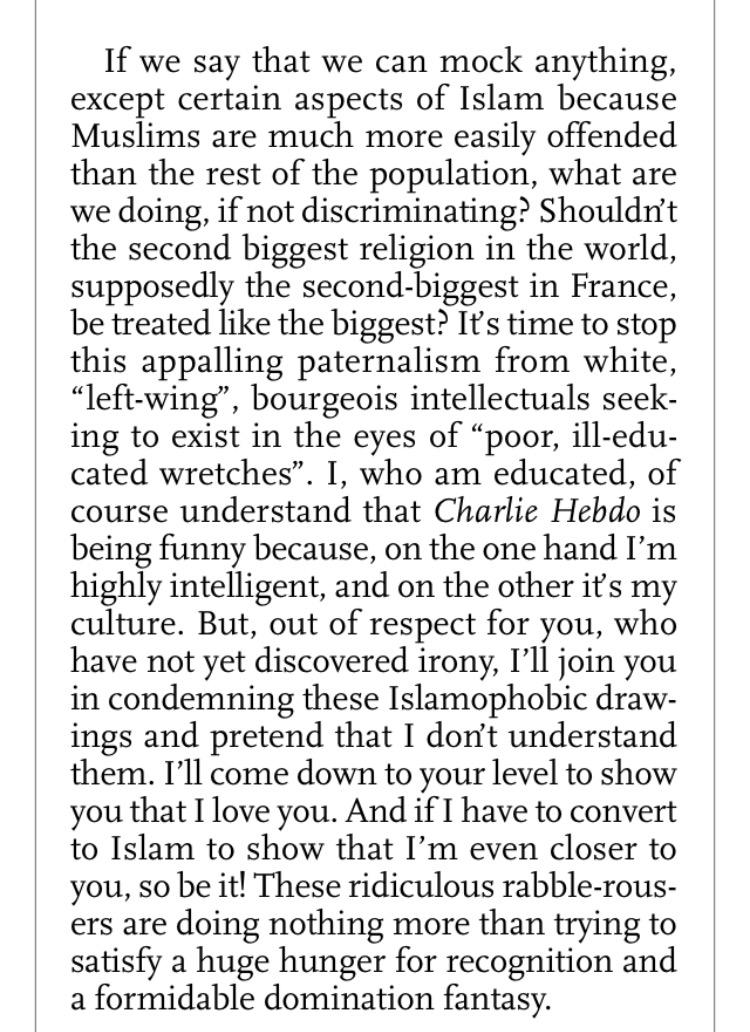
  • Out of respect for you, who have not yet discovered irony

    A useful thing via Twitter:

    Hazem Eseifan @Eseifan 14 hours ago
    #Charlie_Hebdo’s response to its idiotic critics on the American left.

    Embedded image permalink

  • Back to 1989

    The always-wonderful Joan Smith beez wonderful again with her take on Charlie Hebdo.

    Almost 150 well-known writers, including the novelists Joyce Carol Oates and Peter Carey, have written a letter protesting the award. They say they are sickened by the murders but claim the decision to honour the magazine is “neither clear nor inarguable”. They accuse Charlie Hebdo of mocking “a section of the French population that is already marginalised, embattled, and victimised” and causing “further humiliation and suffering” among France’s Muslims.

    Seeing this, my mind flashed to The Satanic Verses. Back in 1989, I was dismayed by the number of people who said that the death sentence passed on Salman Rushdie was wrong, but he shouldn’t have offended Muslims. The historian Lord Dacre even declared that he wouldn’t shed a tear if some British Muslims “were to waylay [Rushdie] in a dark street” and teach him some manners. Defending free speech is easier in principle than in practice, it seems.

    Indeed. My mind has been flashing back to 1989 all week (as has Salman Rushdie’s). It’s a bad thing. It’s bad when people on the left tell other people on the left that they mustn’t rebel against religion because [insert bad reasons here]. Religion is one of our masters, and it’s arguably the most illegitimate of all. The left has no business telling people not to rebel against their masters.

    Curiously, these self-appointed defenders of Europe’s Muslim population are making exactly the same mistake as the people they think they’re opposing; like white racists, they regard “Muslims” as a homogenous group. They see them as uniformly powerless, ignoring the emergence of a Muslim middle class and the enormous power wielded by advocates of extreme forms of Islam. I don’t imagine the secular blogger Raif Badawi, who is still under sentence of 1,000 lashes, would have much time for the argument that the Wahhabi sect which runs Saudi Arabia is mild-mannered and ineffective.

    Or a powerless marginalized group, either.

    The journalists gunned down at Charlie Hebdo – including a French-Algerian copy-editor, Mustapha Ourrad – understood this very well. Some Muslim men (they almost always are men) are very powerful indeed, whether they are the leaders of Boko Haram or the Muslim clerics who encourage impressionable young men to kill people. There are good reasons for being afraid of Islamic extremists, just as I would have gone in fear of the Inquisition if I’d been born in 15th-century Italy.

    Or of the nuns if she’d been born in 20th-century Ireland.

  • New table hosts for PEN America

    Also in pleasanter news: from the New York Times:

    Neil Gaiman, Art Spiegelman and Alison Bechdel are among the writers who have agreed to be table hosts at next week’s PEN American Center gala after six authors withdrew in protest of an award being given to the satirical French magazine Charlie Hebdo.

    So, that will do. That’s not too shabby. Alison Bechdel has a hit musical on Broadway at this moment.

    The literary and human rights organization told The Associated Press this weekend that the other new hosts are George Packer, Azar Mafisi and Alain Mabanckou, a Congolese-born French author who will present the award to Hebdo’s editor in chief Gerard Biard and critic and essayist Jean-Baptiste Thore. PEN is giving the magazine a Freedom of Expression Courage award, a decision that has been fiercely defended and criticized.

    That’s Nafisi, if they mean the author of Reading Lolita in Tehran, as I imagine they do. But anyway – cool beans. I would be ecstatic to sit at any one of those tables.

    “I was honored to be invited to host a table,” Gaiman wrote in an email Sunday to The Associated Press. “The Charlie Hebdo cartoonists are getting an award for courage: They continued putting out their magazine after the offices were firebombed, and the survivors have continued following the murders.”

    Stout fella.

    The literary world has been in a civil war of words since PEN announced last week that Michael Ondaatje, Francine Prose and four other table hosts pulled out from the gala, citing what they say are the offensive cartoons of Muslims in Charlie Hebdo. A stream of tweets, letters, Facebook postings and opinion pieces has divided old friends such as former PEN presidents Prose and Salman Rushdie, a leading backer of the honor, and even set siblings on opposite sides.

    I’ve been reading Joseph Anton again because of all this, and I keep finding tragic-ironic appearances by Peter Carey and Michael Ondaatje and the like. It’s sad.

    Gaiman, in his email to the AP, said he was puzzled that “several otherwise well-meaning writers have failed to grasp that you do not have to like what is said to support people’s right to say it.”

    No, you don’t, but you probably do have to like or at least respect what is said to be happy about an award for it. Being happy about an award is a step or two (or several) beyond supporting people’s right. I agree with the protesting writers about that much. I just think they’re dead wrong about not liking or at least respecting what is said. They are objecting from the left, not from the right, and that’s just a complete mistake. And with so many people explaining the mistake to them, they ought to be able to grasp it.

  • Zainub Priya Dala supports the Charlie Hebdo award

    Zainub Priya Dala posted a note on Charlie Hebdo and free expression v intimidation to my Facebook wall, and gave me permission to quote it. I’m sure you remember her experience of violent intimidation.

    Regarding the PEN American Center’s decision to present the PEN Free Expression Award to Charlie Hebdo:

    In a similarity to my experience, (albeit my assault – on a much smaller scale)… It is not a question of content, but a question of style. Literary satirical style throught the ages has always been met with persecution. It is a style that is poorly understood, where artists attempt to create discourse and debate surrounding an otherwise taboo subject. I support freedom of expression in all its forms, be it admiration of a “banned” writer or a deep dissection of a cartoon in all its complexity. Using violence to silence opinion is tantamount to medieval gagging practices. If we cannot debate sensitive issues without fear of retaliation, we are in no way progressing as a society. The Charlie Hebdo tragedy was disgusting. It was bullying. It was unneccsary loss of lives. An award should be given, a commemoration of sorts…. Otherwise the lost lives will have been in vain. When we venerate people who have been persecuted for their craft, we open the way for courageous people to follow in their wake. I say all this because I knew and still know now the sound of being silenced~zpd

  • Draw The Line Here

    English PEN has a book we can buy.

    English PEN is delighted to announce the publication of Draw The Line Here, a collection of cartoons drawn in response to the Charlie Hebdo attacks in Paris in January 2015.

    The book is a collaboration between the Professional Cartoonists’ Organisation (PCO), Crowdshed, and English PEN. It features cartoons drawn by British artists in the days immediately after the attacks. The work of 66 cartoonists is featured, including Steve Bell, Dave Brown, Martin Rowson, Peter Brooke and Ralph Steadman.

    Books cost UK £15.00 each. Compare that to $250 to attend the “VIP reception” on Dawkins’s June tour

  • Not really a reductio

    Glenn Greenwald thinks people have been misrepresenting the arguments of Francine Prose and Deborah Eisenberg.

    To defend the award to Charlie Hebdo, PEN officials argued that the award did not constitute an endorsement of the content of the cartoonists’ speech, but rather, only a recognition that they were courageous in expressing themselves. The principle articulated by PEN was clear: a person is deserving of this award if they continue to express their views even in the face of credible threats of violence, and especially if they pay for their right to free expression with their lives.

    The objecting PEN writers believe this principle to be invalid and contrived. To prove that point, they offered a hypothetical example that was classic reductio ad absurdum: suppose a KKK leader continued to publish white supremacist filth in the face of credible threats of violence, and was killed for doing so: of course PEN would not bestow the KKK with a courage award, and almost nobody would be comfortable if they had.

    And that far, I agree with the objecting writers. I think PEN put it too strongly when it said that. (Maybe PEN would say yes, a murdered KKK propagandist would be eligible for a courage award from PEN; in that case I would disagree with PEN.) But I don’t consider it a reductio ad absurdum but just an illustration of how the claim says too much. It’s not absurd enough to be a reductio ad absurdum. I think it’s just a competing example; I don’t know if there’s a technical word for that.

    Their point was that the award is not merely about courage, but is clearly linked to a positive assessment of the content of Charlie Hebdo cartoons, as proven by the fact that PEN would never give the award to someone, such as a KKK leader, who expresses heinous views. And since these PEN writers don’t view the content of the cartoons as worthy of admiration, they oppose the award. They believe Charlie Hebdo should have full free speech rights, but not be admired for the content of their speech: the most basic distinction when it comes to free speech advocacy. That’s all there is to it.

    Yes, but that’s not all that such examples can do. They can also poison the well. They can manipulate people who hear and see them. They can re-frame the discussion. The Nazis or the KKK can be a competing example but also a comparison, at least implicitly.

    In her original letter kicking off the controversy, Deborah Eisenberg raised the examples of racist fraternities and Nazi propagandists who express widely reviled views that provoke recrimination and threats, and asked: “Is there not a difference — a critical difference — between staunchly supporting expression that violates the acceptable and enthusiastically awarding such expression?”

    See there? Is that a reductio, or a comparison? It looks to me like more of the latter than the former. I think she’s saying Charlie Hebdo is bad in the same way that racist fraternities and Nazi propagandists are bad. I don’t think it’s at all clear that she considers the racist fraternities and Nazi propagandists obviously far more awful than Charlie; I think she’s saying they’re all much of a muchness.

    Another objecting PEN writer, Francine Prose, wrote an incredibly clear op-ed in the Guardian this morning making clear exactly what her objections are (and are not), and similarly wrote:

    I believe that Charlie Hebdo has every right to publish whatever they wish.

    But that is not the same as feeling that Charlie Hebdo deserves an award. As a friend wrote me: the First Amendment guarantees the right of the neo-Nazis to march in Skokie, Illinois, but we don’t give them an award. The bestowing of an award suggests to me a certain respect and admiration for the work that has been done, and for the value of that work and though I admire the courage with which Charlie Hebdo has insisted on its right to provoke and challenge the doctrinaire, I don’t feel that their work has the importance – the necessity – that would deserve such an honor.

    Same thing, although less coherent – she seems to have thought that Charlie’s badness wasn’t obvious enough in comparison to neo-Nazis and so it was necessary to add badness + lack of necessity to make a big enough sum. But that’s not clearly because she wasn’t trying to say they were both much the same kind of thing.

    Greenwald then gets indignant with Padraig Reidy for taking what Prose wrote at face value. Hmph. I don’t think Padraig is the one making an error here.